Table of Contents
▼
Can a non-resident actually get an EIN in 3 days?
Sometimes. Three days is a best case, not an IRS service level. No one at the IRS promises it, and no provider can guarantee it.
Quick Answer: A non-US resident can get an EIN in about 3 days only when the IRS processes a clean Form SS-4 fast. The realistic IRS windows are 5-15 business days by fax and 4-6 weeks by mail [1]. When a company advertises "EIN in 3 days for non US residents," that number usually describes their own handling time after you send a signed SS-4, not the IRS clock.
Three timelines get mixed together in most articles you will read:
- IRS fax: 5-15 business days [1].
- IRS mail: 4-6 weeks [1].
- Provider-assisted: often quoted as 1-3 business days after a signed SS-4 reaches them. That is their queue, not the IRS queue.
Say your LLC is approved in Wyoming on a Monday and you fax a correct SS-4 that same afternoon. You might have the EIN by Friday. You might also wait two weeks because the fax sits in a queue behind a thousand others. You control the form. You do not control the queue.
Heads-up: the IRS does not publish a guaranteed turnaround for faxed SS-4s. Treat every "3 days" promise as a target, not a commitment.
What an EIN is and why a non-resident LLC needs one
An EIN is the IRS's nine-digit tax ID for your business. It is not an SSN (your personal Social Security number), not an ITIN (an Individual Taxpayer Identification Number for people who file US taxes without an SSN), and not a general TIN. An EIN belongs to the company. The others belong to a person.
You will need the EIN for concrete things, not abstract ones:
- Opening a US business bank account. Most banks ask for it before the account goes live.
- Payment processors. Stripe and similar providers ask for the EIN during onboarding.
- Federal tax filing. A foreign-owned single-member LLC files Form 1120 with Form 5472 attached. The EIN is how the IRS matches that filing to your company.
- Payroll and state registrations. If you hire or register in a state, the EIN goes on the paperwork.
One point people miss: the EIN itself is free from the IRS. Any fee you pay is a provider or agent fee, not a government charge. If you are forming the company first, see US LLC formation for non-residents for the sequence.
The IRS Form SS-4 process for applicants without an SSN
Non-residents file Form SS-4 (the IRS application for an EIN) by fax or mail. The IRS online EIN assistant needs an SSN or ITIN, so it is closed to most non-residents.
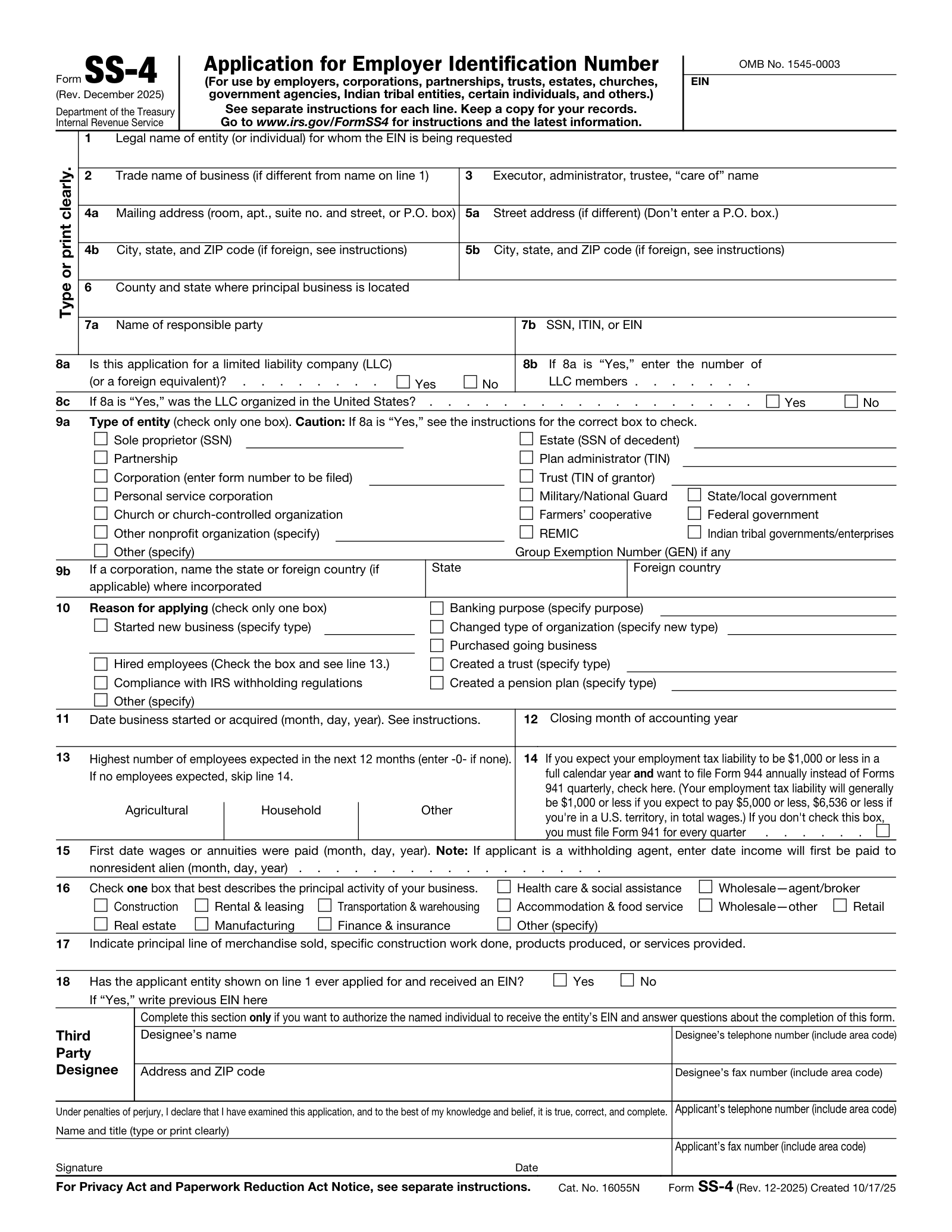
Official form (IRS.gov): Form SS-4 official PDF
The lines that decide whether your SS-4 sails through or bounces back:
- Line 1: legal name. It must match your state filing exactly. "NexFyla Trading LLC" and "NexFyla Trade LLC" are two different companies to the IRS.
- Line 2: trade name. Leave it blank unless you actually operate under a different name.
- Line 8a-8c: entity type. A single-member LLC is a disregarded entity. A multi-member LLC is a partnership by default. Pick wrong and the IRS may rework the file.
- Line 9: reason for applying. "Started new business" covers most founders. "Banking purpose" is for entities that exist only to hold an account.
- Line 7a-7b: responsible party. The individual who controls the company. For most non-resident founders, that is you.
The international phone route exists. The IRS EIN line can sometimes complete an EIN on the phone, but availability varies by agent and by how the entity is classified. Do not build your plan around it.
If the phone route fails, you fax. Fax is the workhorse for non-residents, and it is the channel most of this article's timeline advice assumes.
Why the IRS asks for a responsible party and what that means
The responsible party is the human being who controls the entity. For a non-resident LLC, that is usually the owner-founder. The IRS wants a name attached to a legal person, not just a company.
Here is where non-residents hit friction. The IRS asks for the responsible party's SSN or ITIN on the SS-4. If you have neither, the practical options are to apply for an ITIN with Form W-7 or to state on the form that an ITIN application is pending.
Missing or inconsistent responsible-party details are a top cause of SS-4 rejection. If the name on your SS-4 does not match the name on your passport or your state filing, expect the IRS to send it back. If you need the ITIN before the EIN, applying for an ITIN is the step to start first, because the W-7 timeline adds weeks.
Fax versus phone versus agent-assisted applications
Fax is the most common non-resident route. Phone can be faster when it works. Agent-assisted adds a paid layer of handling but does not change the IRS processing clock.
Here is how the channels compare:
| Channel | Who can use it | Typical turnaround | Government cost | Provider cost | What you control |
|---|---|---|---|---|---|
| Fax | Any non-resident with a complete SS-4 | 5-15 business days [1] | Free | None if you self-file | Form accuracy, fax confirmation |
| Any non-resident | 4-6 weeks [1] | Free | Postage | Form accuracy, delivery tracking | |
| Phone (international) | Some applicants, availability varies | Same call, when accepted | Free | None | Having all details ready on the call |
| Agent-assisted | Anyone who pays | Provider turnaround, then IRS queue | Free | Provider fee | Choosing a reputable provider |
Note: the IRS filing is free in every channel. Any fee is a service fee. If you want the EIN handled alongside the company setup, getting an EIN as a non-US resident covers the assisted route.
What can delay an EIN application
Most delays come from the form, not from your country. An incomplete SS-4, a mismatched legal name, a missing responsible party, or a wrong entity type will hold the file longer than any fax queue will.
Controllable delays:
- Missing entity type on line 8.
- Legal name that does not match the state filing.
- Blank responsible-party line.
- Wrong "reason for applying."
- Sending a second SS-4 before the first one resolves.
- IRS fax queue volume.
- Federal holidays.
- Mail transit time if you choose paper.
Uncontrollable delays:
Resubmitting a duplicate SS-4 does not speed anything up. It can create two files for one company and slow the process down further. Send once, correctly, and keep the fax confirmation.
Suppose you fax on a Friday before a US holiday weekend. Your five business days do not start until the IRS reopens. That is not a rejection. It is a calendar.
How to check application status without misusing IRS lines
The IRS does not offer a public EIN status tracker. The practical check is calling the IRS EIN line with your fax confirmation in hand.
Have these ready before you dial:
- The fax confirmation page, with the date and time sent.
- Your entity's exact legal name.
- The responsible party's name and details.
- The reason for applying you wrote on line 9.
Do not call the general taxpayer line or the online-assistant line. Those teams handle individual returns and SSN-based applications. They cannot see a faxed SS-4 for a non-resident company.
What to do if you need the EIN for banking urgently
Sequence the work so the EIN is requested the same day the LLC is approved. Waiting a week to start the SS-4 adds a week to everything downstream.
Practical order of operations:
- Form the LLC and get the state approval document.
- Fax the SS-4 the same day, with the legal name matching the state filing.
- Keep the fax confirmation. It is your proof of filing date.
- Open the bank account with formation documents if the bank allows it, and add the EIN when it arrives.
- Do not wait for the physical IRS letter before applying. The letter is confirmation, not permission.
Stripe and similar processors ask for the EIN before activation. Plan the order so payments do not block on a number that is still in the IRS queue. If you are choosing a bank, opening a US business bank account covers which providers accept a pending EIN.
Imagine you launch a product page on day one and Stripe will not activate until the EIN lands. That is two weeks of checkout downtime you could have avoided by faxing the SS-4 before you built the page.
Common EIN application mistakes non-residents make
The most common mistakes are using the online assistant (which needs an SSN), leaving the responsible-party line blank, and mismatching the legal name to the state filing. Each one costs you a full processing cycle.
Specific failure modes and fixes:
- Using the online EIN assistant. It needs an SSN or ITIN. Non-residents fax or mail Form SS-4 instead.
- Name mismatch. "ABC LLC" on the state filing and "ABC Inc" on the SS-4 will bounce. Copy the name character for character.
- Blank responsible party. The IRS needs a named human. Fill it in.
- Wrong entity type. Single-member LLC treated as a corporation on line 8 creates a mismatch with your later Form 1120 + 5472 filing.
- Sending the SS-4 before the LLC exists. The IRS needs the entity to exist. Form first, then SS-4.
- Assuming a provider fee buys IRS speed. It does not. It buys handling, not priority.
- Losing the fax confirmation. Without it, you cannot check status or prove your filing date.
Do fax, not mail, if you are outside the US and need the EIN within a month. Skip paper mail unless you genuinely do not need the number for six weeks.
If you are in a hurry and have no ITIN, apply for the ITIN in parallel with the SS-4 rather than waiting for one before starting the other. The two timelines run side by side, not in sequence.
Frequently Asked Questions
Can I get an EIN in 3 days as a non-resident? Sometimes, but it is not guaranteed. Three days is a best case, and it usually reflects a provider's handling time rather than the IRS clock.
Do I need an SSN or ITIN to get an EIN? No SSN is required to file Form SS-4. The responsible party needs an SSN or ITIN, or must indicate an application is pending.
Is the EIN free from the IRS? Yes. The IRS does not charge for an EIN. Any fee is a provider or agent fee.
How long does fax vs mail take? Fax runs about 5-15 business days. Mail runs 4-6 weeks [1].
Can I check my EIN status online? No public tracker exists. The practical route is calling the IRS EIN line with your fax confirmation.
Can I open a US bank account before my EIN arrives? Some banks and processors allow it with formation documents. Others require the EIN first. Plan the sequence.
NexFyla helps non-US founders form US companies and set up EIN and US business banking support. If you want help with US LLC formation, EIN and business setup, NexFyla can assist.
*Last updated: February 2026.*
Why do non-resident EIN requests take longer than domestic ones?
Because the IRS online EIN assistant is closed to you. That tool requires a valid Social Security Number or ITIN for the person applying, and without one you drop into the manual lane: fax or mail on Form SS-4 [1]. Manual means human review, batches, and a paper trail you have to chase yourself.
Quick Answer: A non-US resident gets an EIN by fax or mail on Form SS-4, not online, because the online assistant requires an SSN or ITIN. The IRS targets about 4 business days for fax requests and up to 4-6 weeks for mail, but that clock starts only when a complete, legible form reaches the right office. Most delays are form errors, not queue length.
An EIN is the nine-digit tax ID the IRS assigns to your LLC. You need it to open a US business bank account, connect Stripe, and file your annual return. No EIN, no account, no filing.
That is the whole reason speed matters. You are not chasing a number for its own sake. You are chasing the bank onboarding and the tax deadline behind it.
One more layer of friction: an SS-4 with no US tax ID in the Responsible Party block gets closer reading than a domestic one. A single blank field turns into a written request for more information, and that letter resets your timeline from zero.
If you have not formed the company yet, the entity paperwork comes first. Read US LLC formation for non-residents before you touch the SS-4.
Fax, mail, or phone: which EIN channel is actually fastest for a foreign applicant?
Fax wins. It is the fastest self-serve channel for a non-US resident. Phone only works if you already hold an SSN or ITIN, and mail is the fallback nobody should choose unless fax is impossible.
| Channel | Who can use it | Typical turnaround | Proof of delivery | Main failure mode |
|---|---|---|---|---|
| Online assistant | Applicants with SSN/ITIN only | Same session | None needed | Not available to you |
| Fax (Form SS-4) | Any applicant | About 4 business days per IRS | Fax confirmation page | Wrong fax number, illegible copy |
| Mail (Form SS-4) | Any applicant | Up to 4-6 weeks per IRS | Courier tracking only | Lost post, no return receipt |
| Phone | SSN/ITIN holders | Immediate | None | Blocked without a US tax ID |
The government fee for an EIN is $0 on every channel [1]. Your only cost is a fax service or a courier, and your time.
The IRS publishes separate domestic and international fax numbers on the Form SS-4 instructions. Numbers move. Check irs.gov the morning you send, not a screenshot from a blog.
Keep the fax confirmation page. It is the only receipt a DIY filer gets, and it is the document you quote when you call the IRS three weeks later. Save it with date and time in the filename.
The field-by-field walkthrough lives in getting an EIN as a non-US resident without an SSN. Read it before you fill anything in.
Which SS-4 fields most often trigger an IRS delay?
The Responsible Party block, the reason-for-applying box, the entity type line, and blank fields that should say "N/A". Those four cause most of the pain.
Official form (IRS.gov): Form SS-4 official PDF
Line 7b is where people freeze. It asks for the Responsible Party's SSN or ITIN, and you have neither. The answer is to write "Foreign" in that field. Leaving it blank is the single most common reason a non-resident SS-4 bounces back.
Line 9 is the reason for applying. Tick a box. "Started new business" or "Banking purpose" both fit a new LLC. An empty line 9 tells the IRS nothing and invites a follow-up.
Line 8a is the entity type, and it has to match your state formation document word for word. If Delaware lists you as a "Limited Liability Company" and your SS-4 says "LLC," you have created a mismatch a clerk has to resolve by mail.
Blank fields are not neutral. The IRS instructions tell filers to write "N/A" where a line does not apply. A blank looks like an omission. "N/A" looks like a decision.
Say your Wyoming LLC was formed as "Northwind Trading LLC" but your SS-4 reads "Northwind Trading Co." The IRS has no record tying those names together, so the request sits in a mismatch pile while someone tries to reconcile it. You find out six weeks later, by letter.
How do you avoid a request for additional information?
Send one complete, legible, single-sided fax with every applicable line filled. That is the whole trick. The IRS letter asking for more information is almost always preventable.
Run this checklist before you dial:
- Legal name matches the state formation document exactly, including "LLC"
- Entity type on line 8a matches that same document
- Line 7b shows your SSN/ITIN, or the word "Foreign"
- Line 9 has a box ticked
- Every non-applicable line reads "N/A"
- Signature and title present ("Member" or "Manager" works for an LLC)
- Cover page with your return fax number and phone number
- Correct current fax number, checked on irs.gov that day
If a request for additional information does arrive, answer it by the deadline printed on the letter, using the method the letter specifies, and quote its reference number. Do not start a fresh SS-4. A new form is a new request.
You already filed and heard nothing - what should you do next?
Call the IRS before you refile. Confirm receipt first, then decide. Blind refiling is how founders end up with two EINs and a bank that cannot match either one to their records.
Here is the triage:
- Under 4 business days since fax: wait. You are inside the published window.
- 5 to 15 business days, fax confirmed: call the IRS Business & Specialty Tax Line and ask for status.
- Over 15 business days, fax confirmed: call. If the IRS has no record, refile by fax and mark the cover page "second request."
- No fax confirmation at all: assume nothing was received and refile once, cleanly.
Have these ready for the call: entity name exactly as filed, formation date and state, Responsible Party name, your fax confirmation, and any IRS reference number you have been given.
Suppose you faxed on a Monday and heard nothing by the following Wednesday, nine business days later. That is past the target. Call, give the agent your entity name and fax timestamp, and ask whether the SS-4 is on file. If it is, you wait. If it is not, you refile once and note the original date on the cover page.
Can you start banking or contracting before the EIN arrives?
Mostly no for banking. Yes for some contracts. That split matters more than people admit.
A US business bank or fintech account wants the EIN at onboarding, along with your formation documents and ID. No EIN, no application. That is the practical wall, and it is why founders care about the four-day target.
A payment processor needs the EIN plus a bank account, so it sits behind the bank in the queue. A client contract usually needs only your legal entity name and a signature. Payroll needs the EIN, full stop.
Then there is the deadline you cannot see. A foreign-owned single-member LLC files Form 5472 attached to a pro-forma Form 1120, and you need the EIN to file it. A stalled EIN eats into that runway. What you owe depends on ownership, US-source and effectively connected income, treaty position, state nexus and entity classification. Get a qualified tax professional to map those for your facts.
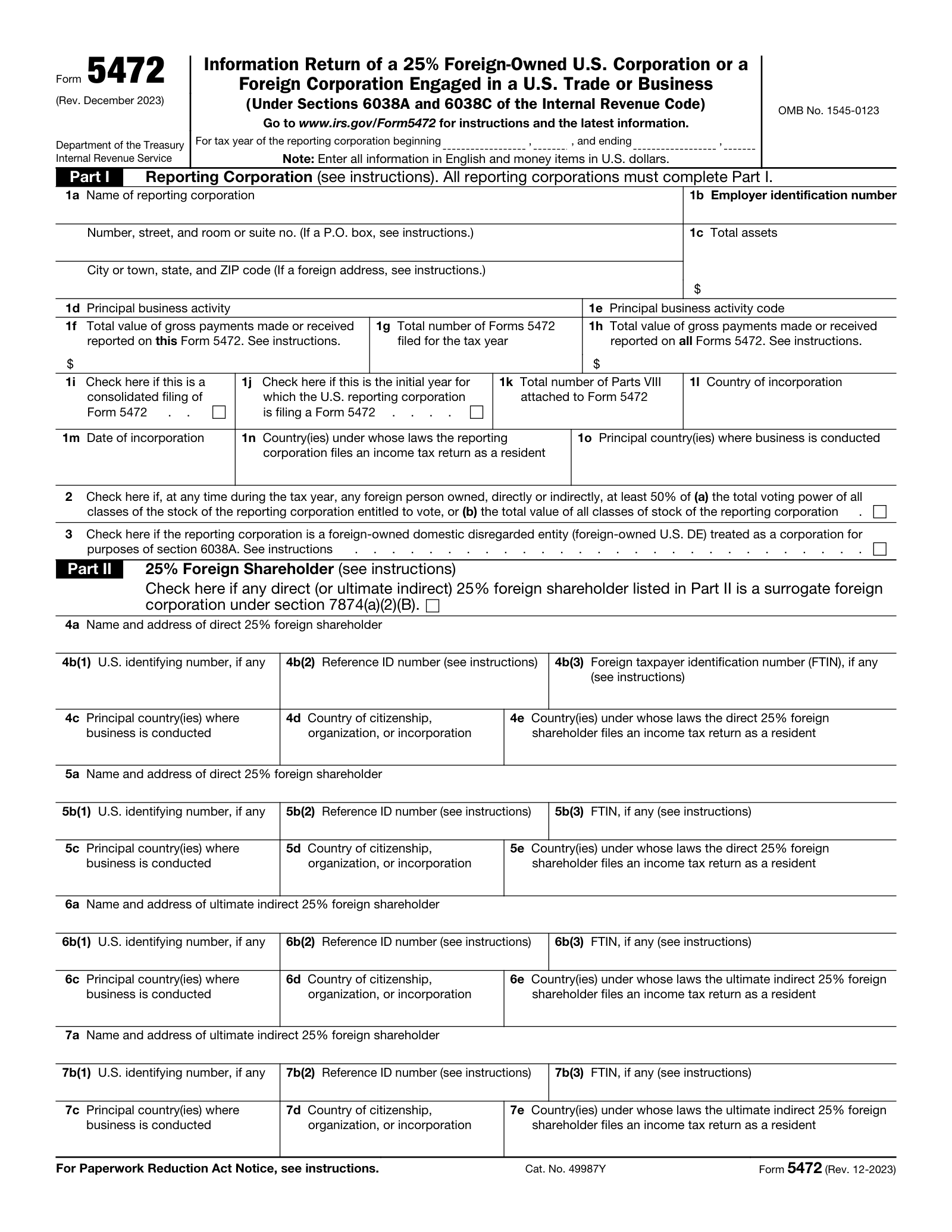
Official form (IRS.gov): Form 5472 official PDF
When the EIN lands, the account step is next. Opening a US business bank account as a non-resident covers what each provider asks for.
How do you follow up without restarting your EIN request?
Call first, keep your original fax confirmation, and resubmit only if the IRS confirms no record exists. A resubmission is a new request, not an escalation. Treat it that way.
International callers may need the number published for callers outside the US rather than the domestic line.
Script the call in four lines: who you are, the entity name and formation date, the date and time you faxed, and the question. "Has the SS-4 been received, and is an EIN assigned?" Then stop talking and let the agent check.
Once the EIN exists, ask for written confirmation by fax. That document is the 147C letter, the IRS's official statement of your EIN, and banks accept it when the CP 575 notice never arrived.
When is a third-party agent worth it, and what does it actually change?
An agent changes who prepares the SS-4 and who chases the follow-up. It does not change the IRS queue. The EIN itself is always free from the IRS [1].
| Route | Government cost | Provider cost | What you actually buy |
|---|---|---|---|
| DIY fax | $0 | Fax service, small | Your own time and error risk |
| Formation bundle | $0 | Varies by provider | Form prep and submission |
| CPA or agent | $0 | Varies by provider | Form prep plus follow-up |
The legitimate mechanism is the third-party designee block on Form SS-4, which authorizes someone to speak with the IRS about your application.
Pay for help in three situations: you have no reliable way to send a fax, you have already received an additional-information letter, or a Form 5472 deadline is close enough that a delay costs you money. Otherwise, DIY is fine and cheap.
Do not pay anyone for the EIN number itself. The IRS issues it free. You are paying for preparation and follow-up, nothing else.
Common Mistakes
- Refiling too early. A second SS-4 can produce a second EIN that conflicts with your bank records and any return already filed under the first.
- Leaving line 7b blank. Write "Foreign" when you have no SSN or ITIN. Blank is the top cause of follow-up letters.
- Name mismatch. The legal name on the SS-4 must match the state formation document exactly, including the "LLC" suffix.
- Using a stale fax number. Numbers change. Check irs.gov on the day you send.
- Trying the online assistant anyway. It rejects applicants without an SSN or ITIN. You will waste an afternoon.
- Paying for the EIN. The number is free. Preparation help is a separate, optional purchase.
- Skipping the fax confirmation. Without it, you cannot prove receipt when you call.
If the filing side is where you want hands off your plate, NexFyla helps non-US founders form US companies and set up EIN and US business banking support. You can see what each package covers on the NexFyla pricing page before you decide anything.
Related reading
- How a Non-US Citizen Gets an EIN From the IRS
- Getting a US EIN as a Non-Resident Entity: What Speeds It Up
- How to Get an EIN for a Non-US Resident in 2026 Without an SSN
Ready to act on this? EIN assistance takes the filing, registered agent and paperwork off your desk.
About the author
Ashwini Dhangar is a Senior Corporate Structuring Specialist and US company formation advisor at NexFyla. She works with non-resident founders on LLC formation, EIN and ITIN filings, and US business banking — and has handled these filings for founders across India, the UK and the Gulf. More about the team · LinkedIn