Table of Contents
▼
What is an EIN, and why does your US LLC need one before anything else?
An EIN is a nine-digit federal tax ID number the IRS issues to a business, and it is free. You need it before a US bank will open an account for your LLC, before Stripe or any payment processor will verify you, and before you file a single federal return. [2]
Quick Answer: An EIN (Employer Identification Number) is the IRS's federal tax ID for your US LLC. The IRS issues it free. Non-residents can get one without an SSN or ITIN by filing Form SS-4 by fax or mail. Your LLC needs the EIN to open a US business bank account, accept card payments, and file federal tax returns.
Four acronyms get mixed up constantly. Here is the split:
- SSN: a Social Security number, for individuals authorized to work in the US. You probably do not have one.
- ITIN: an Individual Taxpayer Identification Number, also for individuals, issued to people who file US taxes but cannot get an SSN.
- TIN: the umbrella term. An SSN, an ITIN and an EIN are all TINs.
- EIN: the business version. It belongs to the entity, not to you.
That last point matters more than it looks. Your LLC is a separate taxpayer in the eyes of the IRS even when it is a single-member disregarded entity. The EIN is how the IRS tracks that entity. Your personal tax ID, if you ever get one, is a different number for a different purpose.
One more split that trips up first-time founders: the state registers your LLC, the IRS issues your EIN. Wyoming or Delaware or New Mexico gives you a filing stamp and an entity number. None of those is a tax ID. You still have to apply to the IRS separately, and that application is the part people get wrong.
If you have not formed the entity yet, start with US LLC formation for non-residents and come back here once your Articles of Organization are approved. The IRS wants your legal name to match state records exactly, and you cannot match what does not exist.
Can you apply for an EIN without an SSN or ITIN?
Yes. The IRS issues EINs to entities whose owner has no SSN and no ITIN. The online EIN assistant is the problem, not the rule.
The online assistant validates the responsible party against SSN or ITIN records. No match, no submission. That is why almost every foreign founder ends up on paper: Form SS-4, faxed or mailed. [4]
So who is the responsible party? The individual who ultimately owns or controls the entity. For a single-member LLC, that is you. The SS-4 asks for that person's SSN or ITIN, and the honest answer for a foreign founder is that you do not have one. You write that on the form rather than leaving the line empty. More on the exact wording below.
The phone option exists, and it is genuinely the fastest route when it works. It does not work for most non-residents. The IRS phone line expects the caller to identify themselves with an SSN or ITIN. If you have neither, you are back to paper.
Say your LLC is formed in Wyoming in March and you want a Mercury account by May. You cannot start with the bank. You start with the SS-4, because the bank's onboarding form has a required EIN field and no workaround. Plan the EIN as week one, not week six.
There is a persistent myth that a formation service can somehow push you through the online portal. It cannot. The portal checks a database. Nobody bypasses a database check. Anyone promising an instant online EIN for a founder with no SSN is describing a service that files the SS-4 for you, which you can do yourself for free.
Form SS-4 line by line for a foreign applicant
Fill every line that applies, write "N/A" where a US-only field does not, and never leave the responsible party section unexplained. The SS-4 is a short form. Precision, not length, is what gets it approved. [4]
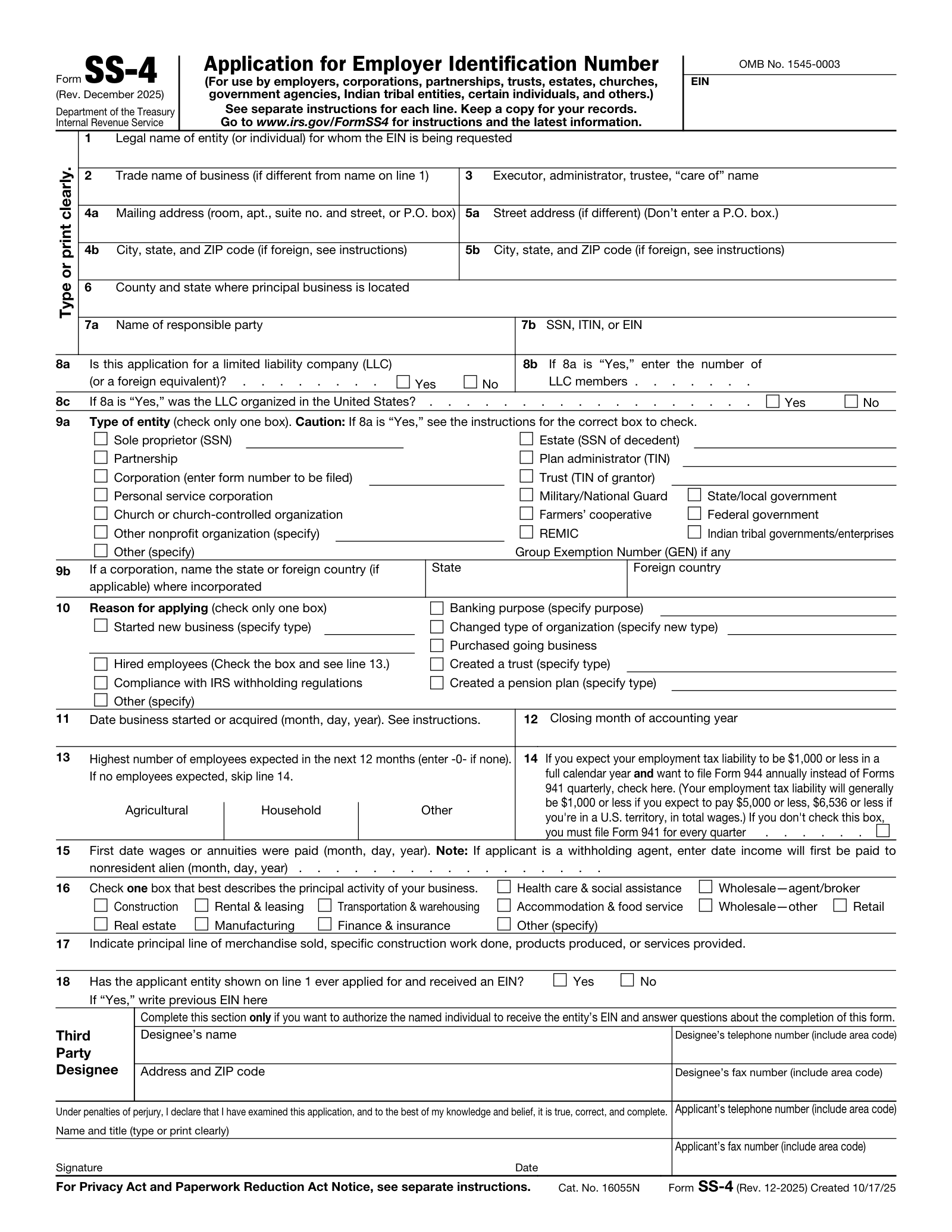
Official form (IRS.gov): Form SS-4 official PDF
Here is the field map. The right-hand column is where non-resident applications actually fail.
| SS-4 field | Typical US applicant | What a non-resident writes | Why it matters |
|---|---|---|---|
| Line 1 legal name | LLC name | Exact name on your Articles of Organization, including "LLC" | A mismatch with state records is the single most common rejection |
| Line 2 trade name | DBA if any | Leave blank unless you registered a DBA | Inventing a brand name here creates confusion |
| Line 3 executor | Usually blank | Blank | Not applicable to most founders |
| Line 4 mailing address | US address | Your home address abroad is acceptable | The IRS mails the CP 575 here, so it must be reliable |
| Line 5 street address | US street address | Registered agent address or your foreign address | Do not use a PO box on line 5 |
| Line 7a-7b responsible party | Name plus SSN | Your full name; see the note below on the SSN/ITIN line | This is the line the IRS scrutinizes hardest |
| Line 8 entity type | Check the box | LLC box, then number of members | Wrong box changes your filing obligations later |
| Line 9 reason for applying | Started new business | "Started new business" or "Banking purpose" | Banking purpose is legitimate and common for foreign-owned LLCs |
| Line 10 date started | Formation date | Your LLC formation date | Blank here delays processing |
| Line 11 date closed | Blank | N/A | Only for entities closing |
| Line 12 closing month | December | December, unless you have a reason | Sets your tax year |
| Line 13 employees | 0 or a number | 0 for most founders | Answer honestly; it drives payroll obligations |
| Line 14-15 prior EIN and prior business | Usually no | No | Only yes if you have genuinely had one |
| Line 16 principal activity | Consulting, retail, etc. | Your real activity | Vague answers invite questions |
| Line 17 description | One line | One line, specific | Same |
| Line 18 prior EIN for this entity | No | No | Do not confuse with line 14 |
On the responsible party's SSN/ITIN line: the SS-4 instructions cover foreign responsible parties, and the current wording is worth reading yourself rather than trusting a blog. Write "Foreign" or "N/A" as the instructions direct, and never leave it blank with no explanation.
Lines 18a to 18c are the third-party designee block. If you want your accountant or a service to speak to the IRS about this application, that is where you authorize it. Do not put their name on line 7 instead. That is a different thing entirely, and it is the next section.
What if the IRS asks for a responsible party who is not you?
The responsible party should be you, the actual owner. If you list a registered agent or a formation service there, the IRS can question it, and you have created a problem for no benefit.
Why do people do it? Usually because the service filled the form. A registered agent is the company that receives legal mail on your LLC's behalf. They are not the owner. Listing them as responsible party misstates who controls the entity, and the IRS notices mismatches like that.
Suppose you used a provider that offers to file the SS-4 for you. Ask to see the completed form before it goes out. Check line 7. If it has the provider's name, stop and fix it. You are the owner; the form should say so.
The correct way to let someone else deal with the IRS on your behalf is the third-party designee block on the SS-4 itself, or a separate authorization. Form 2848 is a power of attorney for tax matters. Form 8821 authorizes someone to receive your tax information. Both are formal, both are separate from the SS-4, and both are things you file when there is a real need, not by default.
My call: put yourself on line 7, every time. If you want your CPA copied on IRS correspondence, use the designee block. Skip the arrangement where a provider's name appears as owner. It saves nothing and costs you a correction later.
How should a non-resident submit Form SS-4: fax, mail, or phone?
Fax. For a non-resident, fax is the practical default: fastest paper route, international-friendly, and you get a transmission receipt as proof of filing.
| Channel | Who can use it | Typical speed | How you do it | Caveats |
|---|---|---|---|---|
| Fax | Anyone, including foreign applicants | Days to a couple of weeks | Send to the IRS fax number for your state or for international applicants | Keep the confirmation page |
| Anyone | Several weeks | Post to the IRS address for your state; certified mail recommended | Slower, and harder to prove delivery | |
| Phone | Callers with an SSN or ITIN | Same call | IRS Business & Specialty Tax Line | Not available to most foreign founders |
| Provider or CPA filing | Anyone, paid | Depends on the provider | They prepare and send the SS-4 | A service fee, not a government fee |
The government fee for an EIN is zero. The IRS issues EINs free. [2] Any money you pay goes to a provider, an agent or a CPA for their time. Keep those two numbers separate in your head when you compare options.
For the fax route: print the completed SS-4, sign it, add a short cover sheet with your name, your LLC name, your return fax number and your email, then send it to the correct IRS fax number. International fax numbers change, so check irs.gov the week you file rather than trusting a screenshot.
For mail: same form, same signature, sent to the IRS address for your state or the international address. Use tracked post. If the letter vanishes, you want a record.
A faxed signature is accepted. You do not need to courier an ink original.
How long does the EIN take, and how do you check status?
Fax runs days to a couple of weeks. Mail runs several weeks. Phone is immediate when you qualify, which most non-residents do not. Those are ranges, not commitments, and IRS backlogs move them.
When the EIN is assigned, the IRS sends a CP 575, the original notice with your number on it. Keep it. Banks and payment processors ask for it, and some ask for it months after onboarding.
If you lose the CP 575, you request a 147C letter, which is the replacement confirmation of your EIN. Same number, different document. You will need it if a bank rejects a scanned CP 575 or asks for a fresh letter with a recent date.
To check status, call the IRS Business & Specialty Tax Line and have your LLC name, your name, your formation date and your fax confirmation date ready.
Imagine six weeks pass with no CP 575. Do not file a second SS-4 with a different name variant, because that creates duplicate-entity confusion. Call first. If the line confirms nothing was received, refax the same form with a cover note saying "second submission, original sent on [date]."
Common Mistakes
Most rejections come from four things: blank required lines, a legal name that does not match state records, the wrong entity type box, or an incomplete responsible party section. All four are fixable before you fax.
| Mistake | Why it triggers a rejection or delay | The fix |
|---|---|---|
| Legal name differs from the Articles of Organization | The IRS cannot match the entity to state records | Copy the state filing exactly, including "LLC" |
| Responsible party SSN/ITIN line left blank | Incomplete application | Write what the instructions require for a foreign responsible party, not nothing |
| Registered agent listed as responsible party | Misstates who owns the entity | Put your own name on line 7 |
| Wrong reason for applying | Inconsistent with your activity | "Started new business" or "Banking purpose" |
| Missing date started on line 10 | Incomplete | Use your formation date |
| No signature | The form is not valid | Sign it; a faxed signature is fine |
| Illegible fax | Data entry errors downstream | Send a clean print, not a photo of a print |
Heads-up on timelines: an SS-4 rejection usually comes back as a returned form or a letter, not a phone call. If you move house and forget to update the mailing address on line 4, you may never see the notice and you will assume silence means processing.
If your application does come back, the IRS normally tells you which line is the problem. Fix that line, refax, and keep the second confirmation. Do not rewrite the whole form from scratch; a fresh version invites fresh errors.
What should you do with the EIN once it arrives?
Store the CP 575 as a PDF and in a folder you will still have in three years, then use the EIN for three things: a US business bank account, payment processing, and federal filings.
Start with banking. A US business bank account is what turns an LLC from a registration into an operating company. Fintech options and brick-and-mortar banks both ask for the EIN, your formation documents and ID. An LLC makes you eligible to apply; approval stays the provider's decision, and no honest service can promise it. If you want the online route, see opening a US business bank account as a non-resident. If you would rather walk into a branch, the in-person path is covered separately.
Then payments. Stripe and similar processors verify your business against the EIN and your ownership details. Same rule: eligibility, not a guarantee.
Then taxes, which is where foreign-owned LLCs get surprised. A single-member LLC owned by a non-resident is by default a disregarded entity, but it still has an annual federal filing obligation: Form 5472 attached to a pro forma Form 1120. Miss it and the penalty is severe. This is not optional paperwork you can skip because the LLC made no US-source income.
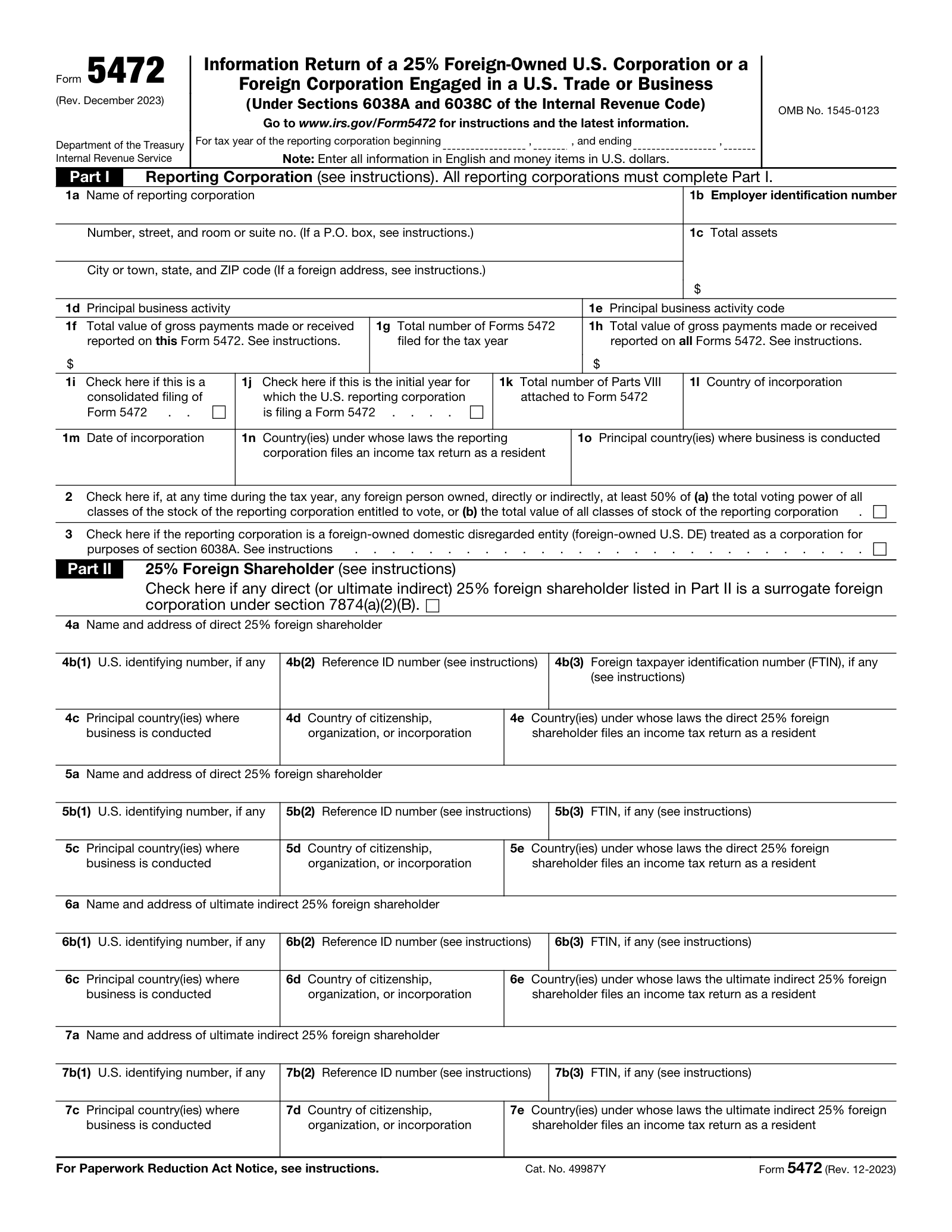
Official form (IRS.gov): Form 5472 official PDF
When a US payer asks you for a W-8BEN-E, that is the entity-level withholding certificate, and it is separate from both the EIN and Form 5472. Do not confuse the three.
State obligations run on their own track. Annual reports and state fees have nothing to do with your EIN, and paying one does not cover the other.
If you want the filing side handled, federal tax support for Form 5472 and Form 1120 exists for exactly this. And if you still need the number itself, getting an EIN as a non-US resident is the step before all of this.
Frequently Asked Questions
Can I get an EIN without an SSN or ITIN? Yes. The IRS issues EINs to entities whose responsible party has neither. You apply on Form SS-4 by fax or mail because the online assistant validates SSN and ITIN records.
What do I write on the SS-4 line for the responsible party's SSN? Enter your full name on line 7a. For the SSN/ITIN entry, follow the current SS-4 instructions for foreign responsible parties and do not leave the section blank without explanation. Read the instructions on irs.gov the week you file.
Is the online EIN application available to non-residents? No, for most. The online assistant requires an SSN or ITIN. Without one, you use Form SS-4.
How long does an EIN take for a non-resident? Fax is usually days to a couple of weeks. Mail can take several weeks. Phone is same-day but requires an SSN or ITIN. Verify current IRS processing times before you plan around them.
Does it cost anything to get an EIN? The IRS issues EINs free. Any charge comes from a provider, agent or CPA helping you prepare or send the form.
What if my SS-4 is rejected? The IRS normally returns it with the reason. Fix the flagged line, usually a blank field, a name mismatch or the responsible party section, then refax or remail and keep the new confirmation.
Can I use the EIN before the CP 575 arrives? Yes, once the IRS has assigned the number. Many founders get the EIN confirmed by phone before the letter lands. Banks may still ask for the CP 575 or a 147C, so keep both routes in mind.
*Last updated: February 2026.*
What is an EIN and why do you need one as a non-US resident?
An EIN is a free nine-digit federal tax ID number issued by the IRS to businesses. Non-US residents need one to open a US business bank account, use payment processors like Stripe and PayPal, file US tax returns, and hire employees.
Quick Answer: A non-US resident can get an EIN without an SSN or ITIN by filing IRS Form SS-4 by fax or mail. The EIN is free, issued by the IRS, and used for banking, payments, and tax filing. Fax processing typically takes 5–15 business days; mail takes 4–6 weeks [1].
An EIN is not the same thing as an SSN, ITIN, or TIN, and mixing them up is the single most common reason non-residents get stuck before they even start.
- SSN (Social Security Number): for US citizens and authorized workers. You cannot get one from abroad.
- ITIN (Individual Taxpayer Identification Number): for individuals who must file a US personal tax return but cannot get an SSN. It is issued by the IRS but is not an EIN.
- TIN (Taxpayer Identification Number): the umbrella term. An EIN, SSN, and ITIN are all TINs.
- EIN (Employer Identification Number): the business tax ID. This is what you want.
If you have formed a US LLC or corporation — or plan to — you need an EIN. The IRS issues EINs for free, directly, and the number belongs to the entity, not to you personally [9].
You need one even if you have no US employees, no US office, and no plans to set foot in the country. A foreign-owned single-member LLC that is treated as a disregarded entity still has to file Form 5472 (an information return for foreign-owned US corporations and LLCs) and it still needs an EIN to do that. Banking and payment processing come first in practice, though — most US banks and Stripe will not open an account or approve a merchant profile without an EIN.
If you are still deciding on the entity itself, our US LLC formation guide covers state choice and filing.
Why can't non-residents use the IRS online EIN tool?
The IRS online EIN tool requires a valid SSN or ITIN, and it is reserved for entities with US addresses and US taxpayer IDs. Non-residents apply with Form SS-4 instead — by fax or mail [7].
That is the whole answer. The online tool is fast and free, but it will reject an application that has a foreign address in the principal place of business field or a responsible party without an SSN or ITIN. The IRS designed it for US persons, and it stays that way.
Here is the part people get wrong: you do not need an SSN or ITIN to get an EIN. You need one to use the *online* tool. Those are different requirements, and the second one does not apply to you.
Do not apply for an ITIN just to use the online tool. An ITIN application (Form W-7) can take months, requires you to send your passport or a certified copy to the IRS, and buys you nothing here — you would still be filing Form SS-4 by fax or mail anyway. Skip it.
Who is eligible for an EIN as a non-resident?
Non-resident individuals, foreign corporations, foreign partnerships, non-US trusts, and foreign-owned LLCs that do business in the US or must file a US tax return are all eligible to apply for an EIN [2][10].
Eligibility is not about citizenship or residency. It is about whether the entity has a US tax filing or withholding obligation, or needs the number for a US bank or payment processor. The IRS list includes entities that:
- Have employees or plan to hire in the US
- Have excise tax liability
- Withhold taxes on income paid to a non-resident alien
- File a return for a foreign-owned disregarded entity (Form 5472)
- Need an EIN for banking, credit, or payment processing
A single-member LLC owned by a non-resident is a disregarded entity for federal tax purposes by default. It has no separate income tax return of its own — but it must file Form 5472 with a pro forma Form 1120, and to do that it needs an EIN. This is the exact case most guides skip over.
You can apply for an EIN with no US bank account, no US office, and no US phone number. What you cannot do is apply online.
If you have not formed the LLC yet, start with EIN for non-US residents after formation — the order matters, because the SS-4 asks for the entity's formation date and state.
How do you fill out Form SS-4 correctly as a non-resident?
Fill out every required line, put your own name and foreign address in the responsible party section, and leave the SSN/ITIN boxes blank if you do not have one. That is the core of it.
Official form (IRS.gov): Form SS-4 official PDF
Here is the line-by-line that matters for a non-resident LLC:
- Line 1 — Legal name: the exact name on your Articles of Organization (the state filing that creates your LLC). If the state added "LLC" and you left it off, use the state's version.
- Line 2 — Trade name: only if you operate under a different name. Otherwise blank.
- Line 3 — Executor, administrator, trustee: leave blank unless it applies.
- Line 4a/4b — Mailing address: your real mailing address, even if it is outside the US. A registered agent address works if you can receive mail there.
- Line 5a/5b — Street address: your business address. Foreign address is fine.
- Line 6 — County and state where principal business is located: the US state where the LLC is registered.
- Line 7a/7b — Responsible party: your full legal name. This is a person, not the company.
- Line 7b — SSN/ITIN: leave blank if you have neither. Do not invent a number.
- Line 8 — Is this an LLC? Check "Yes" and select the number of members.
- Line 9 — Type of entity: check the box that matches how the LLC is taxed. A single-member LLC owned by a non-resident is usually "Other" with "Disregarded entity" written in.
- Line 10 — Reason for applying: "Banking purposes" or "Started new business" are the usual answers.
- Line 11 — Date business started: the date your LLC was approved by the state.
- Line 12 — Closing month of accounting year: December, unless you have a reason to change it.
- Line 13 — Employees: enter 0 if you have none.
- Line 14 — Excise tax: enter 0 unless it applies.
- Line 15 — First date wages paid: blank if no employees.
- Line 16 — Principal activity: the closest fit for what the business does.
- Line 17 — Describe the business: one sentence is enough.
- Line 18 — Prior EIN: blank if this is the first one.
- Third Party Designee: leave blank unless you want someone else to speak to the IRS for you.
- Signature: sign it. An unsigned SS-4 gets rejected.
Tip: Use the current revision of Form SS-4 from irs.gov. An old revision can trigger a rejection.
Fax vs mail: which method is faster for non-residents?
Fax is faster. Fax applications typically take 5–15 business days; mail takes 4–6 weeks [1]. If you are not in a hurry and want a paper trail, mail is fine. If you need the EIN to open a bank account this month, fax it.
| Method | Timeline | Cost | Requirements | Best for |
|---|---|---|---|---|
| Fax | 5–15 business days [1] | Cost of fax service (varies) | A return fax number the IRS can send the EIN to | Urgent applications |
| 4–6 weeks [1] | Postage | Trackable mail recommended | Applications with no deadline | |
| Online | Minutes | Free | US SSN or ITIN — not available to non-residents | US persons only |
| Phone | Varies | Free | International applicants only; check current availability | Rare cases |
The fax route has one requirement people miss: include a return fax number on the form. The IRS sends the EIN back by fax. If you use an online fax service, confirm it can *receive* faxes, not just send them. A service that only sends will leave you waiting for a notice that never arrives.
Heads-up: the IRS fax number for Form SS-4 and the mailing address change from time to time. Check the current "Where to File Your Taxes" page or the SS-4 instructions before you send anything. ## How long does it take to get an EIN as a non-resident?
Fax: 5–15 business days. Mail: 4–6 weeks [1]. Those are the working numbers, and they assume a complete, correctly signed form.
Incomplete applications are the main cause of delay. A missing signature, a blank responsible party line, or an old form revision can push you to the back of the queue, and you will not get an email telling you why.
What speeds things up:
- Double-check every field against the SS-4 instructions before sending
- Include a return fax number if you are faxing
- Use trackable mail if you are mailing
- Use the current revision of the form
If you have a fax confirmation and it has been longer than the expected window, you can try the IRS international line to check status. ## What should you do after submitting Form SS-4?
Wait for the IRS to assign the EIN and send it back — by fax if you provided a return fax number, or by mail as a CP 575 notice. You can start using the EIN as soon as it is assigned, even before the notice arrives.
If the expected window passes with nothing:
- Check your fax service's received-fax log. The EIN may already be sitting there.
- Call the IRS international line with your fax confirmation and entity details.
- If the IRS rejected the application, correct the errors and resubmit by fax or mail.
Keep the CP 575 notice. Banks, payment processors, and your accountant will ask for it, and replacing a lost notice takes another IRS request. If you never receive the notice but the IRS has assigned the number, you can request a letter confirming the EIN.
Once the EIN is in hand, the next practical steps are a US business bank account and payment setup with Stripe or a similar processor. Both will ask for the EIN, the formation documents, and proof of address for the responsible party.
What is an EIN, and why does your US LLC actually need one?
An EIN is the IRS's free federal tax ID for a business. It belongs to the company, not to you, which is why a non-US citizen can hold one without an SSN or ITIN.
The IRS calls it an Employer Identification Number and issues it to businesses, tax-exempt organizations and other entities [3]. Ignore the word "employer." You do not need employees. A single-member LLC with one foreign owner and zero staff still needs an EIN.
Here is the distinction that trips people up. A TIN is the umbrella term for taxpayer identification numbers, issued either by the Social Security Administration or by the IRS [1]. Your SSN or ITIN is a personal number. Your LLC's EIN is an entity number. Two different things, two different applications.
Why you need the entity one, in practice:
- US business bank account. Almost every bank and fintech asks for the EIN on the application.
- Stripe and payment processors. Onboarding forms ask for the company's tax ID before they approve your account.
- W-9 requests. A US client that pays you will ask for a W-9, and the W-9 wants the EIN. Without it, some clients withhold or stall payment.
- Federal filings. Your LLC's returns go out under the EIN.
It costs nothing. The IRS issues EINs free [3]. Any number you see attached to an EIN is a provider or agent service fee, not a government fee. Keep those two buckets separate when you budget.
If you have not formed the entity yet, start with US LLC formation for non-residents. The EIN comes after the Articles of Organization are filed, because the IRS wants your formation date and legal name.
Can you use the IRS online EIN application without an SSN or ITIN?
No. The online assistant requires the responsible party to enter a valid SSN or ITIN, and it validates that number against IRS records. With neither, you cannot get past that screen.
This is the most common wall non-US founders hit. You read that the IRS lets you apply online in minutes [3], you open the form, you reach the identification field, and you are stuck. A foreign address does not get you past it. A passport number does not get you past it. The tool is checking for an SSN or ITIN, full stop.
Who can use the online route: US citizens, green-card holders, and anyone who already holds an SSN or ITIN. That includes some non-residents. If you already have an ITIN from a previous US tax filing, try the online application first.
Now the part people misread. You do not need to be a citizen, a resident, or an ITIN holder to get an EIN. The IRS issues EINs to entities, and a foreign-owned entity qualifies. You are eligible. You are just not eligible for that particular tool.
The IRS publishes the EIN routes side by side: online, fax, and mail [2]. Online is the fast lane. Fax and mail are the lanes open to you.
Do not apply for an ITIN just to open the online form. An ITIN takes months and exists for your personal tax return, not your company's tax ID. If you genuinely need one later, read how to apply for an ITIN then.
Filing Form SS-4 by fax or mail: the route that works for non-residents
File Form SS-4, Application for Employer Identification Number, and send it by fax or mail. Fax is faster because you give the IRS a return fax number and they send the EIN back the same way.
Official form (IRS.gov): Form SS-4 official PDF
The mechanics:
- Download the current SS-4 from irs.gov. Do not use a copy a friend saved two years ago.
- Fill it in, then print and sign where required, or complete it electronically if your version supports it.
- Fax it to the number listed in the SS-4 instructions for applicants with no legal residence in the US.
- Or mail it to the IRS address for entities without a US legal residence.
Say your LLC was formed in Wyoming last week and you are sitting in Pune with the SS-4 open. You fill it out, fax it on a Monday, and put your own fax number on the return line. By Friday the EIN comes back on the fax machine. That is the whole process, and it costs you the price of a fax.
Suppose instead you mail it because you do not have a fax. The same form goes by post, the IRS opens it weeks later, and the reply letter travels back to India. Plan on that being slow.
The phone route is not open to you. The IRS phone line for EINs serves applicants who can identify themselves with an SSN or ITIN.
What do you put on the SS-4 when you have no SSN or ITIN?
Leave the SSN and ITIN fields blank where they do not apply, and complete the entity, responsible-party and reason-for-applying fields accurately. A blank personal ID field is correct here. A wrong one causes a rejection.
The lines that matter for a foreign-owned LLC:
- Line 1, legal name. Copy it exactly from your Articles of Organization. "Tech Labs LLC" and "Techlab LLC" are different names to the IRS.
- Line 2, trade name. Your brand name, if it differs. Otherwise leave it blank.
- Lines 4 and 5, mailing address. Your Indian address is fine. The IRS does not require a US address on the SS-4.
- Line 7a, entity type. Check "Limited liability company" and enter the number of members.
- Line 7b, LLC classification. A single-member LLC owned by one person checks "Disregarded entity" and enters the owner's name. A multi-member LLC checks "Partnership." Pick wrong here and the IRS will question the whole filing.
- Line 8, reason for applying. "Started new business" fits most founders. "Banking purpose" fits if the bank is the one demanding the EIN.
- Line 9. Skip it unless you are a corporation or a specific exempt entity.
- Line 10, reason. "Banking purpose" or "To open a US business bank account" is enough.
- Line 11, date business started. Your formation date.
- Line 18, responsible party. The human who controls the entity. More on this below.
A foreign phone number on the form is acceptable. So is a foreign mailing address. The IRS is asking who you are, not where your office is.
Note: line numbers shift between revisions of the form. Check your entries against the revision you downloaded before you fax.
If you are unsure how your LLC is classified for US tax, the classification feeds directly into federal tax support for Form 5472 and Form 1120 later, so get it right now.
Responsible party vs contact person: who goes where on the form?
The responsible party is the real person who controls the entity. That can be you, sitting in Bengaluru with no SSN and no ITIN. The contact person is whoever the IRS can call about the application, and that can be a third party.
Put yourself down as responsible party. You own the company, you control it, and you are the person the IRS wants on record. A foreign address does not disqualify you. No SSN does not disqualify you.
Do not let an agent talk you into listing a nominee as responsible party. It creates a paper trail that contradicts your ownership, and it gets messy the first time a bank or the IRS asks who actually controls the LLC.
The contact person field is different. If a formation agent is filing on your behalf, they can be the contact person so the IRS calls them instead of you across time zones. You can also authorize a third-party designee to receive the EIN on your behalf.
Imagine you are traveling for three weeks and cannot watch a fax machine. You name your agent as contact person, they receive the EIN, and they forward it. Your name stays on the responsible party line. That is the clean version.
How long does it take, and how do you follow up if nothing arrives?
Online is immediate. Fax with a return fax number is days, not weeks. Mail is the slow route.
If nothing comes back, call the IRS Business & Specialty Tax Line and reference your fax date. Have a copy of the SS-4 in front of you, because they will ask for the legal name and the date you sent it.
If the IRS needs more information, they contact you using the details on the form. Answer fast. A stalled SS-4 stalls your bank account and your Stripe onboarding behind it.
If the EIN was issued but the letter never reached you, request an EIN verification letter, often called a 147C letter, by phone. It confirms the EIN on IRS letterhead, which is what a bank wants when you cannot produce the original notice.
About the author
Ashwini Dhangar is a Senior Corporate Structuring Specialist and US company formation advisor at NexFyla. She works with non-resident founders on LLC formation, EIN and ITIN filings, and US business banking — and has handled these filings for founders across India, the UK and the Gulf. More about the team · LinkedIn