
Table of Contents
▼
What does a Wyoming LLC actually cost a non-resident in 2026?
A bare-bones Wyoming LLC costs about $100 to the state plus $50–$150 for a registered agent in year one. Realistically, a non-resident should budget $400–$900 in year one and $150–$400 every year after once EIN handling, banking minimums and compliance are counted.
Quick Answer: Wyoming's LLC filing fee is $100. A registered agent (a person or company with a physical Wyoming address who accepts legal mail for your LLC) costs $50–$150 a year. The IRS charges nothing for an EIN or ITIN. Realistic year-one cost for a non-resident is $400–$900; ongoing years run $150–$400, plus $300–$800 if a preparer handles your Form 5472.
Three buckets, and mixing them up is why people get surprised:
- Government fees — Wyoming Secretary of State and the IRS. Small, fixed, unavoidable.
- Provider fees — registered agent, EIN or ITIN handling, formation service. Optional in theory, near-mandatory in practice for a non-resident.
- Recurring compliance — annual report, registered agent renewal, Form 5472. This is the bucket that grows.
The IRS issues an EIN (Employer Identification Number, your company's tax ID) and an ITIN (Individual Taxpayer Identification Number, a personal tax ID for people without an SSN) at no charge. Any "EIN fee" you see is a provider's service charge for preparing or forwarding your paperwork.
Note: Wyoming's fee schedule is published as a PDF on the Secretary of State site, and the state updates it periodically. Confirm the current numbers against the official schedule before you pay anything.
How much is the Wyoming state filing fee in 2026?
Wyoming's LLC filing fee is $100, whether you file online or by mail. Filing online adds a 2.4% credit card processing fee, minimum $1, which brings the online total to about $102.40. [3]
That $100 buys you exactly one thing: the Articles of Organization, the one-page document that legally creates your LLC. It does not include a registered agent, the annual report, your EIN, or a business bank account. [8]
Separately, Wyoming charges an annual report / license tax with a minimum of $60 for LLCs holding under $300,000 in Wyoming-situated assets. It scales above that threshold. [2] That fee is due in your LLC's anniversary month, every year, including years when the LLC earned nothing.
Heads-up: the $60 is a floor, not a flat rate. If your LLC ever holds Wyoming real estate or other Wyoming assets above $300,000, the license tax is calculated on asset value instead.
If you want the filing itself handled end to end — Articles, registered agent, the works — US LLC formation for non-residents walks through what's included at each tier.
What does a registered agent cost, and can a non-resident skip it?
No, a non-resident cannot skip it. Wyoming requires every LLC to name a registered agent — a person or company with a physical street address in Wyoming who can accept legal documents and state mail on the LLC's behalf during business hours. A non-resident physically cannot fill that role, so this is a permanent recurring cost: $50–$150 per year at commercial rates. [8]
Watch the "free first year" offer. Plenty of formation packages advertise a low headline price with registered agent service bundled in for year one. The renewal lands in month 13, and it is frequently priced higher than the formation fee itself. That is the single most common budgeting miss on this topic.
What you get for the money varies a lot. Basic tiers give you the address and mail forwarding. Better ones add scan-to-email, a compliance calendar, and annual report reminders. If you run an online business and never receive physical mail, the cheap tier is fine. If you expect contracts or bank correspondence, scan-to-email is worth the extra.
One thing people get wrong: a registered agent address is not a usable business address for banking or IRS correspondence. Banks and the IRS want your real operating address, and using your agent's address in the wrong field causes verification problems later.
EIN and ITIN: what do they really cost a non-resident?
Nothing, from the IRS. An EIN and an ITIN are both free. You pay a provider only when you use one to prepare or forward Form SS-4 (the EIN application) or Form W-7 (the ITIN application). Typical market rates run $75–$250 for EIN handling and $200–$500 for ITIN assistance through a Certified Acceptance Agent — a professional authorized to verify your passport without you mailing the original.
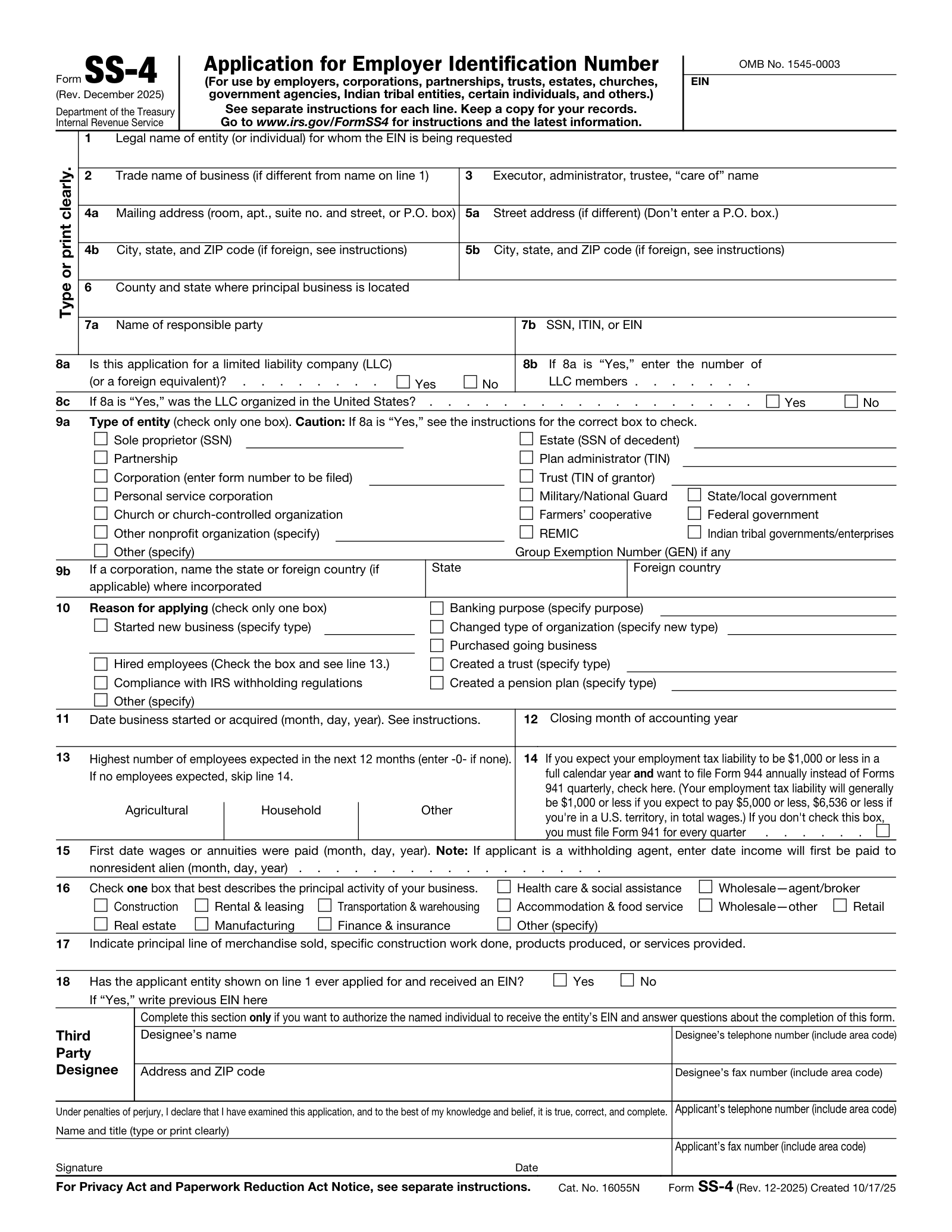
Official form (IRS.gov): Form SS-4 official PDF
You need an EIN in almost every case. Banks require it to open a business account, and the IRS requires it to file your returns. You need an ITIN only if you personally file a US tax return, claim treaty benefits, or hit a bank that insists on a personal tax ID for the signer.
Non-residents blow the SS-4 on three lines. The responsible party must be a real person — not your LLC, not your registered agent. The box stating you have no SSN or ITIN must be ticked correctly. And the third-party designee section is where a provider authorizes itself to speak to the IRS on your behalf. Get those right and the EIN typically arrives by fax within a few business days.
If you expect to file a personal US return, applying for an ITIN covers the W-7 route and when an Acceptance Agent is worth paying.
What does banking and payment setup cost for a non-resident-owned Wyoming LLC?
Opening a US business account as a non-resident costs $0 to open, then $0–$30 a month in maintenance, plus wire fees of roughly $15–$45 each way, and possible minimum balances from $0 to $5,000. The monthly fee is rarely the expensive part — wires and balance requirements are.
The realistic split:
- US fintech business accounts (Mercury, Wise Business, Payoneer) — remote onboarding, no branch visit, usually no monthly fee, but they verify hard. Expect to provide your EIN, a US phone number, and a verifiable business address before approval.
- Traditional US banks that accept non-resident applicants — often require an in-person visit, a larger opening deposit, and a higher minimum balance. Slower, but some clients and lenders prefer them.
No bank or fintech is obligated to approve you. An LLC makes you eligible to apply; approval is always the provider's decision, and it depends on your documents, your business type, and the country you operate from.
Payment processing sits in a different bucket. Stripe and PayPal charge per transaction, not a fixed monthly cost, and their underwriting for non-resident founders is stricter than their public pricing pages suggest. If that's your next step, Stripe setup for non-US founders covers what the application actually asks for.
Tip: budget the wire fees before you pick a bank. A founder moving $10,000 a month in and out pays far more in wire charges than the $0 monthly plan saves.
Annual renewal and compliance fees: what hits after year one?
Every year, a Wyoming LLC pays three things: the annual report / license tax (minimum $60), the registered agent renewal ($50–$150), and — for a foreign-owned single-member LLC — Form 5472 filed with a pro-forma Form 1120. Preparer fees for that pair typically run $300–$800, and the IRS penalty for not filing starts at $25,000. [2]
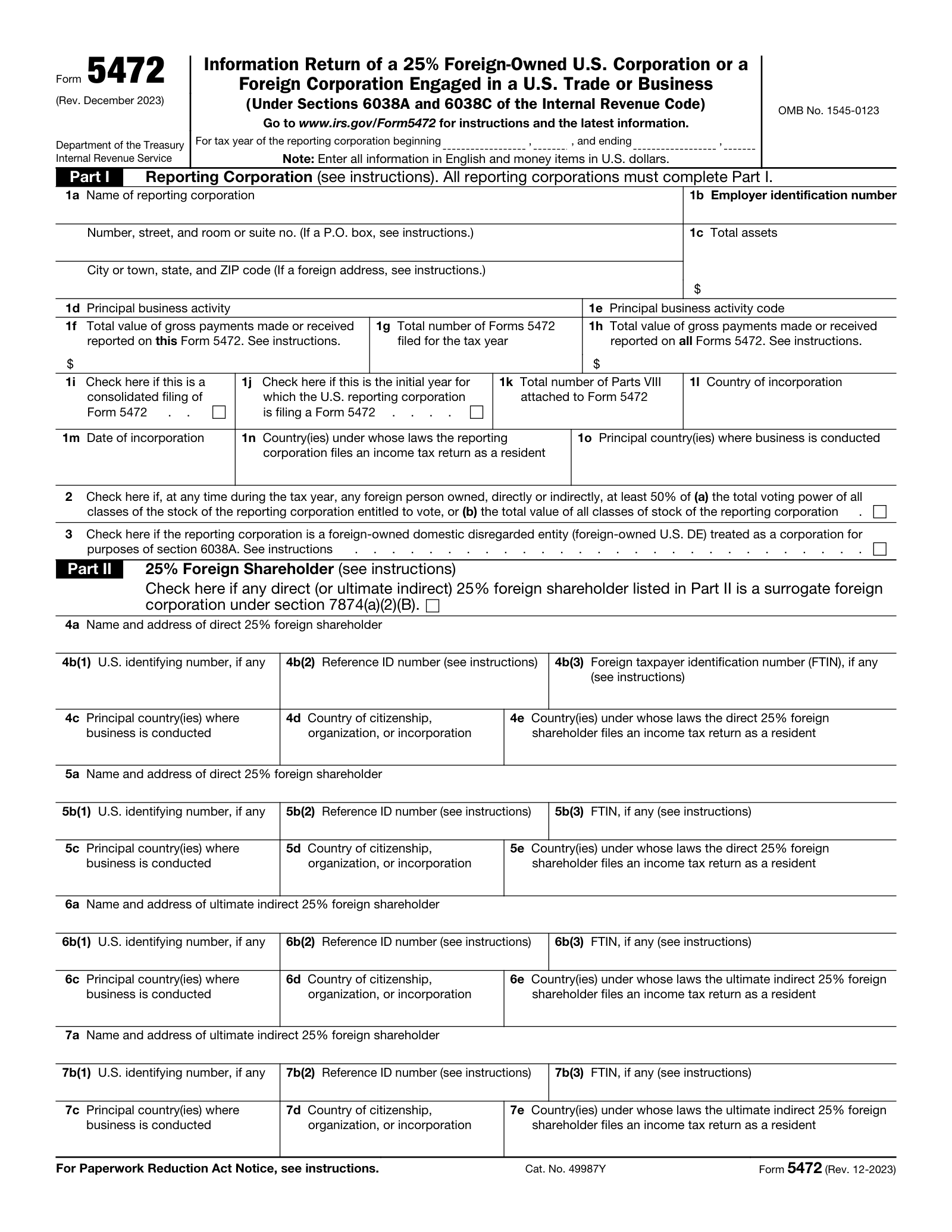
Official form (IRS.gov): Form 5472 official PDF
Form 5472 is the item almost nobody discloses up front, and it is the biggest recurring compliance cost for a non-resident. Here is the shape of it: a single-member LLC owned by a non-US person is a disregarded entity for US tax purposes — the IRS ignores it and taxes the owner directly. But that same LLC must file Form 5472 to report transactions between the LLC and its foreign owner, attached to a pro-forma Form 1120 that carries almost no numbers. It's an information return, not a tax bill. Skip it and the penalty starts at $25,000.
A Wyoming LLC with zero Wyoming-source income still owes the annual report fee. There is no "inactive" exemption. [2]
Sales tax is a separate question entirely. If you sell into other states, economic nexus rules may create registration and filing obligations there. That's outside this article's scope, but it exists, and it costs money.
Federal tax is where the variables live: your ownership structure, whether you have US-source or effectively connected income, any treaty position, your state nexus, and your entity classification election. No article can tell you your number. A qualified tax professional can. For the filing mechanics, federal tax support for foreign-owned LLCs covers Form 5472 and Form 1120.
Total first-year vs ongoing cost: a side-by-side comparison
Here is the honest comparison for a Wyoming LLC non-resident cost, split by year and by who gets the money. Government fees are what the state and IRS charge. Provider fees are what a company charges you to handle the paperwork. Recurring items repeat every year.
| Cost item | Type | Bare minimum (DIY) | Typical provider bundle | Full service |
|---|---|---|---|---|
| Wyoming LLC filing fee | Government | $100 | $100 (bundled) | $100 (bundled) |
| Online credit card fee (2.4%, min $1) | Government | $2.40 | $2.40 | $2.40 |
| Registered agent — Year 1 | Provider | $50–$150 | $0 (free first year) | Included |
| Registered agent — Year 2+ | Recurring | $50–$150 | $100–$200 | $50–$150 |
| EIN handling | Provider | $0 (self-file SS-4) | $75–$250 | Included |
| ITIN (only if needed) | Provider | $0 (self-file W-7) | $200–$500 | $200–$500 |
| Business bank account | Recurring | $0–$30/mo | $0–$30/mo | $0–$30/mo |
| Annual report / license tax | Government, recurring | $60+ | $60+ | $60+ |
| Form 5472 + pro-forma 1120 | Provider, recurring | $0 (self-file) | $300–$800 | $300–$800 |
| Mail forwarding / US phone | Provider | $0–$20/mo | Often bundled | Often bundled |
| Year 1 total | $400–$900 | $500–$1,000 | $600–$1,200 | |
| Year 2+ total | $150–$400 | $300–$700 | $400–$900 |
The "cheap provider" trap in one line: a $150 headline often becomes $400+ by the end of year two once the agent renewal and Form 5472 preparation land. The headline price is real. It just isn't the total.
If you want to see how those tiers map to actual packages, NexFyla pricing lists the components separately so you can compare like for like.
Common mistakes non-residents make when budgeting for a Wyoming LLC
Treating the formation fee as the whole cost. The registered agent renewal arrives in month 13 and is not in the headline number. Build it into your year-one budget now.
Paying a provider for an EIN thinking the IRS charges for it. The EIN is free. You are buying the provider's handling of Form SS-4, which is a legitimate service if the form intimidates you — just know what you're paying for.
Missing Form 5472. This is the expensive one. The penalty starts at $25,000, and it applies even if your LLC had no income and no activity.
Choosing a bank on the monthly fee alone. A $0 monthly account with $45 wires and a $5,000 minimum balance costs more than a $15/month account with free transfers for most founders.
Letting the annual report lapse. Wyoming can administratively dissolve the LLC, and reinstatement fees stack on top of the missed report fee.
Using the registered agent's address as your business address. Banks and the IRS verify addresses. Use your real operating address where they ask for it, and your agent's address only in the registered agent field.
Forgetting the ITIN line item. If you'll file a personal US return or claim treaty benefits, that is a separate $200–$500 cost most budgets skip.
Frequently Asked Questions
Can a non-resident form a Wyoming LLC without ever visiting the US?
Yes. Wyoming requires no residency and no in-person filing. The Articles, the EIN via Form SS-4, and a fintech business account can all be handled remotely. [4]
Is the EIN really free for non-residents?
Yes. The IRS issues EINs at no charge. Any "EIN fee" is a provider's service charge for preparing or forwarding Form SS-4.
What happens if I don't file the Wyoming annual report?
Wyoming can administratively dissolve the LLC and charge reinstatement fees on top of the missed annual report fee. [2]
Do I need an ITIN to open a US business bank account for my Wyoming LLC?
Usually no. An EIN is typically enough, though some banks ask for an ITIN for the signer. Requirements vary by institution — confirm with the specific bank before you apply.
What is Form 5472 and why does it cost me money every year?
It's an IRS information return required for foreign-owned single-member LLCs treated as disregarded entities, filed with a pro-forma Form 1120. Preparers typically charge $300–$800, and the penalty for not filing starts at $25,000.
How much should I budget for the first two years of a Wyoming LLC?
Roughly $400–$900 in year one and $150–$400 in year two for a bare-bones setup. Add $300–$800 per year if a preparer handles Form 5472. These are ranges, not quotes — your numbers depend on your provider and your banking choices.
NexFyla helps non-US founders form US companies and set up EIN and US business banking support. If you want help with US LLC formation, EIN and business setup, NexFyla can assist.
*Last updated: February 2026.*
Why do foreign owners choose Wyoming, and where does that stop?
Wyoming is popular with non-US residents because it has no state personal income tax, lets non-residents own a US LLC, and keeps annual filings short. That is the whole pitch. It does not remove federal US tax duties, and it does not give you a US bank account.
For a wyoming llc for non us residents, the state is genuinely easy to work with. The Wyoming Secretary of State publishes a plain summary of its business entities, and the one thing it repeats is that owners do not have to live in Wyoming [4]. You file, you pay, you keep a registered agent, and you file once a year.
Then the easy part ends.
A Wyoming LLC is a state registration. Nothing more. It does not make you a US tax resident, and it does not exempt you from IRS filings. A foreign-owned single-member LLC still files Form 5472 with a pro forma Form 1120 every year, even with no US income. That is a federal rule, and Wyoming has no say in it.
Banking is the second place people stop. A Wyoming LLC makes you *eligible* to apply for a US business account. Approval stays with the bank or fintech. Nobody can promise it.
So the honest framing is this: Wyoming gives you a cheap, private, low-maintenance shell. You supply the compliance and the banking work.
If you have already decided, US LLC formation for non-residents covers the filing and registered agent side.
How do you file the Articles of Organization from abroad?
File the Articles of Organization (the one-page document that creates your LLC) online through the Wyoming Secretary of State's wyobiz portal, pay the state fee, and name a registered agent with a physical Wyoming address. No SSN or ITIN is needed to file.
That last point surprises people. The state does not ask for a US tax ID at formation. You can form the LLC first and get the EIN afterwards.
The Articles ask for a few things:
- LLC name, which must be distinguishable from existing Wyoming entities and end in LLC or a permitted equivalent
- Registered agent name and Wyoming street address
- Principal office address, which can be your address in India
- Organizer signature, which is whoever files the document
Online filing through wyobiz is faster than paper. The Secretary of State's own start-a-business page links both routes and the current fee schedule [4].
Separate the three cost layers
Most guides quote one all-in number. That hides the structure. There are three layers, and only one of them is a government fee:
| Cost layer | Who gets paid | Recurs? |
|---|---|---|
| Articles of Organization filing fee | Wyoming Secretary of State | No, one time |
| Registered agent service | Commercial agent | Yes, every year |
| Formation service fee (optional) | The provider | No, one time |
The state filing fee is on the Wyoming fee schedule [4]. Check it there before you budget, because it changes.
Say your formation quote is one bundled price. Ask the provider to split it into state fee, their fee, and the first year of registered agent service. If they will not split it, you cannot tell what year two costs, and year two is the number that matters.
What does the registered agent requirement actually cover?
Wyoming requires every LLC to keep a registered agent (a person or company with a physical Wyoming street address) to accept legal papers and state mail on your behalf. A non-resident owner almost always hires a commercial agent, because using a friend's address creates real problems.
The agent's job is narrow. It receives service of process if someone sues the LLC. It receives state correspondence, including your annual report reminder. It signs for official mail.
It does not file your taxes. It does not forward all your business mail unless you buy that add-on. It does not act as your US office for banking purposes by default.
| Option | Works for non-residents? | The catch |
|---|---|---|
| Commercial registered agent | Yes | Annual provider fee, every year |
| Wyoming friend or family address | Legally possible | They get served legal papers; address changes break filings |
| Virtual office | Sometimes | Must be a real physical address and the agent must consent |
Registered agent service is a provider fee, not a government fee. It renews annually. Budget for it as a permanent cost of holding the LLC, not a startup cost.
Heads-up: if your agent lapses, the state can mark your LLC delinquent. That is the quiet way non-residents lose a company.
How does a non-resident get an EIN for a Wyoming LLC?
File IRS Form SS-4 by fax or mail. The EIN (Employer Identification Number, the LLC's federal tax ID) is free from the IRS. You do not need an SSN or ITIN if the responsible party uses the "applied for" box on the form.
The online EIN application only works if the responsible party has an SSN or ITIN. Most non-residents do not, so the paper or fax route is the real one.
Fax is faster than mail in practice.
Write the form carefully. The responsible party is the human who controls the LLC, not the LLC itself. Put your foreign address where the form asks for the responsible party's address, and attach the reasonable-cause statement explaining why you have no ITIN.
Cost: zero. The IRS charges nothing for an EIN. If a provider charges you, that is their service fee for handling the paperwork, and that is fine as long as you know which is which.
You need the EIN before opening a bank account, hiring US contractors, or filing Form 5472. Get it early. For the step-by-step walkthrough, see getting an EIN as a non-US resident.
What does Wyoming require in the annual report each year?
Every Wyoming LLC files an annual report (the yearly state filing that keeps the LLC alive) in the anniversary month of formation, and pays a license tax based on Wyoming assets. Miss it and the state can dissolve the LLC.
Anniversary month means the month your LLC was formed. Formed in March, file in March, every year. Not December. Not "sometime in spring."
The license tax is the greater of a minimum amount or a small rate applied to assets located in Wyoming.
Here is the part most guides get vague. The calculation is based on Wyoming assets. A software business run from Bengaluru with no property, inventory or equipment in Wyoming has essentially nothing to count. In practice, that means the minimum. A company holding Wyoming real estate is a different story.
Say your LLC formed in September 2025. Your first annual report is due in September 2026, and it is a government fee paid to the state, separate from your registered agent renewal. Two bills, two payees, same month.
Tip: Wyoming lets you register an email address for annual report reminders through the Secretary of State [4]. Do it the week you form the LLC.
How does a non-resident set up a bank account and payment processor?
Most traditional US banks want an in-person visit plus a US address and phone. Many non-residents use fintech business accounts or a payment processor instead, and both accept foreign owners with an EIN and formation documents. Approval is always the provider's decision.
Documents requested, in roughly this order:
- Articles of Organization
- EIN confirmation letter (CP-575 or the 147C letter)
- Operating agreement (the internal document naming members and ownership percentages)
- Passport
- Proof of address abroad
| Route | What it needs | Cost shape |
|---|---|---|
| Traditional US bank | Often in-person, US address, sometimes a US phone | Account fees vary by bank |
| Fintech business account | EIN, formation docs, passport, sometimes a minimum deposit | Varies |
| Payment processor | EIN, business website, product description | Per-transaction fees, not annual |
A note on Stripe Atlas: it is a formation bundle, not a bank. It helps you incorporate and apply for a Stripe account. It does not guarantee approval, and it does not replace an EIN application you control.
For the account side, opening a US business bank account walks through the fintech route. If you need a brick-and-mortar relationship, that is a different process entirely.
Which federal tax filings can a foreign-owned Wyoming LLC face?
A single-member LLC owned by a non-resident is disregarded by default. The LLC files Form 5472 with a pro forma Form 1120, and the owner files Form 1040-NR for US-source income. A multi-member LLC files Form 1065 and issues K-1s to members.
The Form 5472 package is the one people miss. It is due with the LLC's return, on the same schedule as Form 1120.
Failure to file carries a penalty that starts in the tens of thousands of dollars per form. That is not a rounding error, and it applies even when the LLC earned nothing in the US.
Other filings that come up:
- FBAR (FinCEN 114) if your foreign financial accounts cross the threshold.
- Form W-8BEN or W-8BEN-E so US payers withhold at the treaty rate instead of the default rate
- State sales tax if you sell taxable goods into states with economic nexus rules
IRS filing fees are zero. Accountant fees are not, and they vary widely by complexity. A clean single-member LLC with no US-source income is a much smaller job than a multi-state e-commerce operation.
This is where I stop giving advice and point at a professional. Your result depends on ownership, US-source and effectively connected income, treaty position, state nexus and entity classification. Get a qualified tax professional to confirm your filing set before your first due date, not after.
Federal tax support for Form 5472 and Form 1120 covers that filing map.
What records should a non-resident owner keep for state and federal purposes?
Keep formation documents, the EIN letter, the operating agreement, annual report confirmations, registered agent invoices, bank statements and tax returns. The IRS expects business records kept for at least three years after filing, and longer for some record types.
Split them into two folders:
- State records: Articles, annual report receipts, agent correspondence
- Federal records: returns, Form 5472, FBAR confirmations, W-8BEN copies
Keep both in cloud storage you can reach from anywhere. Banks and processors ask for these documents at random, and a frozen account with no paperwork is a bad week.
Imagine a payment processor freezing your balance and asking for your operating agreement and EIN letter within 48 hours. If those live on a laptop in another country, you are stuck. If they live in a shared folder, you send two PDFs and move on.
The next step
Do the math before you file. Add the state filing fee once, then the annual report license tax and the registered agent renewal every year after. That yearly total is what holding a Wyoming LLC actually costs you, and it is the number to compare against the revenue you expect.
Then put two dates in your calendar: your formation month for the Wyoming annual report, and your federal return due date for Form 5472. Everything else is detail.
If you want help with US LLC formation, EIN and business setup, NexFyla can assist. NexFyla helps non-US founders form US companies and set up EIN and US business banking support. Start with the filing, keep the calendar, and treat compliance as a fixed cost of doing business in the US.
*Last updated: February 2026.*
Related reading
- Wyoming LLC Requirements for Non-Resident Owners
- Opening a Wyoming LLC as a Non Resident: A Checklist
- Wyoming LLC Non-Resident Bank Account: How to Open One in 2026
Ready to act on this? US company formation takes the filing, registered agent and paperwork off your desk.
About the author
Ashwini Dhangar is a Senior Corporate Structuring Specialist and US company formation advisor at NexFyla. She works with non-resident founders on LLC formation, EIN and ITIN filings, and US business banking — and has handled these filings for founders across India, the UK and the Gulf. More about the team · LinkedIn