Table of Contents
▼
Which costs are set by the state and which are service fees?
State filing fees are mandatory government charges. Service fees are optional payments to a formation provider, registered agent, or address service. Mixing the two is the biggest reason Indian founders over-budget for a US company.
Quick Answer: Registering a US company from India means paying a mandatory state filing fee (roughly $50 to $500 for an LLC, depending on state) plus optional service fees if you use a provider. The IRS EIN is free. Recurring costs, not the one-time filing fee, decide your real first-year spend.
You can file the Articles of Organization (the document that creates the LLC) yourself by mail or online with the state. You pay only the state fee. A provider gives you speed, a US address, a registered agent, and someone to chase the paperwork. That is a real convenience. It is not a legal requirement.
Keep three buckets separate in your head:
| Bucket | Who gets paid | Mandatory? | Typical range |
|---|---|---|---|
| Government fees | State, IRS | Yes | $50 to $500 one-time, plus annual |
| Provider/service fees | Formation agency, registered agent, address | No, but often practical | $50 to $300 per service |
| Recurring banking/currency | Bank, payment gateway, FX | Depends on usage | Varies by provider |
Suppose you file a Wyoming LLC yourself. You pay the state filing fee, buy a registered agent service (legally required), and skip the formation package. You have saved the provider's setup fee and kept the two things you actually need. That is the lean route, and it works. If you want one vendor to handle filing, registered agent, and EIN support in a single order, use a formation provider and accept the markup. For the step-by-step process, see US LLC formation for non-residents.
State filing fees for common formation states
Filing fees for an LLC run from about $50 in New Mexico to $500 in Massachusetts. Delaware charges $90 for an LLC and $89 for a C-Corp. Wyoming charges $100. California charges $70 to file, then adds an $800 minimum annual franchise tax.
That last number matters more than the filing fee. A cheap filing state with an expensive annual obligation is not cheap.
| State | LLC filing fee | C-Corp filing fee | Annual obligation (LLC) |
|---|---|---|---|
| Delaware | $90 | $89 | No annual report for LLCs; C-Corps pay franchise tax (minimum around $400) |
| Wyoming | $100 | $100 | Annual report around $60 |
| New Mexico | $50 | Check the current official fee | No annual report |
| California | $70 | Check the current official fee | $800 minimum franchise tax |
Fees change. Confirm the current number on the state Secretary of State website before you pay.
Delaware is the default for venture-backed C-Corps because investors expect Delaware law. For a solo founder selling services or software, Wyoming or New Mexico usually wins on total cost. Delaware calculates C-Corp franchise tax on authorized shares, and the minimum alone runs several hundred dollars a year.
Registered agent and business address costs
A registered agent is a person or company with a physical street address in the formation state who accepts legal papers on your behalf. Most states require one. It costs roughly $50 to $300 per year. [7]
You cannot use a PO box. You cannot use your flat in Bengaluru. The agent must be reachable at a real address inside that state during business hours.
A business address is different. It is where your mail goes and what you put on your bank application. It is optional as a legal matter, but a US mailing address makes banking and customer trust easier. Expect $50 to $200 per year for a mail-forwarding or virtual address service. Some formation providers bundle registered agent and address into one annual package. That is convenient, but it hides the line items. Ask for the breakdown before you buy.
Say your Wyoming LLC has a registered agent at $100 a year and a virtual address at $100 a year. That is $200 recurring before you have earned a rupee. Budget it as a fixed cost, not a surprise.
EIN and ITIN costs and when each is needed
The EIN (Employer Identification Number, the company's tax ID) is free from the IRS. The ITIN (Individual Taxpayer Identification Number, a personal tax ID for people without an SSN) is also free from the IRS, but you file Form W-7 and often pay a Certified Acceptance Agent to verify your documents.
Paid EIN assistance exists because the process is awkward from abroad. A non-resident without an SSN cannot use the online EIN tool. You file Form SS-4 by fax or mail, and you wait. Many providers charge a fee to prepare and submit the form for you. That fee buys convenience, not a faster IRS.
You need an EIN to open a US business bank account and to file your company's federal returns. You need an ITIN only if you personally have US tax filing obligations and no SSN. Company formation does not require an ITIN.
If the SS-4 and W-7 paperwork is where you get stuck, getting an EIN as a non-US resident walks through it without an SSN.
Banking and payment gateway setup costs
Business bank account costs range from $0 at fintech platforms to monthly maintenance fees and minimum balances at traditional banks. Payment gateways charge per transaction. Stripe publishes a standard rate of 2.9% plus $0.30 per successful card charge for domestic cards.
Traditional US banks usually want an in-person visit and a US address. Some ask for an SSN. Fintech platforms built for founders accept remote applications, but they are not banks, and approval is their decision. An LLC makes you eligible to apply. It does not guarantee an account.
Watch the recurring line items: monthly account fees, incoming wire fees, minimum balance requirements, and card foreign transaction fees. A $0 monthly account with a $25 incoming wire fee costs more than a $15 monthly account if you wire often. For the account options, see opening a US business bank account.
Imagine you take $5,000 in US card payments in month one. At Stripe's published rate you keep roughly $4,830 before refunds and disputes. That is the real cost of getting paid, and it belongs in your budget from day one.
Annual report and franchise tax obligations
Annual report fees run from $0 in New Mexico to around $60 in Wyoming and $800 minimum franchise tax in California for an LLC. Delaware LLCs file no annual report but pay a flat annual tax. Delaware C-Corps pay franchise tax calculated on authorized shares.
Heads-up: miss the deadline and the state charges a penalty and eventually administratively dissolves the company. A dissolved company cannot bank, sign contracts, or defend a lawsuit.
| State | LLC annual | C-Corp annual |
|---|---|---|
| Wyoming | Annual report around $60 | Annual report plus franchise tax |
| Delaware | Flat annual tax, no report | Franchise tax, minimum around $400 |
| New Mexico | None | Check the current official fee |
| California | $800 minimum franchise tax | $800 minimum franchise tax |
These are recurring costs. Put the deadline in your calendar the day you form the company.
Currency, payment method, and foreign card issues
Paying US fees with an Indian card triggers currency conversion markups and foreign transaction fees. Expect a 2% to 5% spread on conversion and 1% to 3% in foreign transaction charges, depending on your bank and card.
Some US services decline Indian cards outright. A US business bank account or a multi-currency account solves this, because you pay US vendors from a US account in dollars.
Tip: compare the all-in rate, not the headline fee. A platform quoting "zero markup" still earns on the exchange rate. Check what actually lands in the recipient's account.
Building a realistic first-year budget
A lean first year for a Wyoming or New Mexico LLC lands around $500 to $1,000. A comfortable first year with a formation package, address, and banking setup runs $1,000 to $2,000. A Delaware C-Corp costs more because of franchise tax.
Here is a sample Wyoming LLC budget, filed yourself with a registered agent:
| Item | One-time | Recurring (year 1) |
|---|---|---|
| State filing fee | $100 | |
| Registered agent | $100 | |
| Business address | $100 | |
| EIN | $0 | |
| Bank account | $0 to $180 | |
| Annual report | $60 | |
| Total | $100 | $260 to $440 |
Add the formation provider package and you add a few hundred dollars. Add a Delaware C-Corp and franchise tax replaces the annual report line.
Common Mistakes
- Assuming the EIN costs money. It is free from the IRS. A provider fee is for assistance, not the number.
- Choosing a state on the filing fee alone. California's $70 filing fee hides an $800 annual minimum. Wyoming's $100 filing fee is the cheaper total.
- Skipping the registered agent to save $100. The state rejects the filing without one, and you pay again to fix it.
- Using a home address in India on the formation documents. The registered agent address is what goes on the state record.
- Forgetting the annual report. The penalty and dissolution cost more than the fee you skipped.
- Paying US vendors with an Indian card and ignoring the FX markup. It quietly adds 3% to 5% to every bill.
Frequently Asked Questions
Do I need to pay for an EIN as an Indian founder? No. The EIN is free from the IRS. You file Form SS-4 by fax or mail. Paid services exist for assistance only.
What is the cheapest state to register a US company from India? New Mexico has the lowest filing fee and no annual report. Wyoming and Delaware are popular but carry different ongoing costs.
Are there annual fees I must pay after registration? Yes. Most states require an annual report or franchise tax. Wyoming charges around $60, California has an $800 minimum, and Delaware C-Corps pay franchise tax.
Can I use my Indian credit card to pay US fees? Yes, but expect foreign transaction and conversion fees. Some US services decline Indian cards, so a US account or multi-currency account helps.
How much should I budget for the first year? A lean LLC runs $500 to $1,000. A comfortable setup with a provider package runs $1,000 to $2,000. C-Corps cost more.
Do I need a registered agent in the US? Yes, most states require one with a physical address in the state. Services cost $50 to $300 per year.
NexFyla helps non-US founders form US companies and set up EIN and US business banking support. If you want help with US LLC formation, EIN and business setup, NexFyla can assist. Check NexFyla pricing before you commit.
*Last updated: February 2026.*
What is the real cost of registering a US company as an Indian resident in 2026?
A bare-bones LLC in a low-fee state can be registered for roughly $100-$200 in government fees. A realistic first-year all-in budget for an Indian founder is $500-$1,500, and $800-$2,500+ if you add ITIN help, a CPA for federal filings, and banking workarounds.
Quick Answer: An Indian resident can own 100% of a US LLC or C-corp without a visa or US address. State filing fees run about $50-$500 [7]. The IRS charges nothing for an EIN (Form SS-4) and nothing to file Form 5472 or Form 1120. The real money goes to the state every year, your registered agent, and a CPA.
Three buckets. Keep them separate or you will overpay.
- Government fees - state filing, annual report or franchise tax. IRS forms cost $0.
- Provider fees - registered agent, formation service, US address, phone number.
- Recurring costs - agent renewal, state annual report, CPA, bank and payment fees.
All figures below are USD. At an approximate rate of ₹83-₹88 to the dollar, a $1,000 budget is roughly ₹83,000-₹88,000 - and the rate moves, so convert on the day you pay.
Which state should an Indian founder pick, and what does each one charge?
For most Indian solo founders with no US investors, Wyoming or New Mexico is cheapest and simplest. Delaware is the default only if you plan to raise US venture capital. Texas makes sense if you have real operations there.
| State | LLC filing fee | Annual obligation | Registered agent | Notes for non-residents |
|---|---|---|---|---|
| Wyoming | ~$100 | ~$60 minimum annual license tax | Required | Cheapest clean option for a plain LLC |
| Delaware | $110 | $300 annual LLC franchise tax | Required | Default for VC-backed C-corps, not for a solo LLC |
| Texas | $300 | Franchise tax applies | Required | No state income tax, higher upfront fee |
| New Mexico | ~$50 | No annual report | Required | Lowest ongoing admin |
| California | $70 | $800 minimum franchise tax | Required | The trap - you pay $800/yr even with zero revenue |
The Delaware confusion is worth clearing up. A Delaware LLC pays a flat $300 annual franchise tax. A Delaware C-corp does not pay a flat $300 - it pays a franchise tax calculated from authorized shares and other factors, which can be far higher. Most blog posts blend the two. They are different taxes on different entity types.
One more trap: if you form in Wyoming but actually run the business from Texas, Texas can require you to foreign qualify - register again in Texas and pay a second set of fees. Formation state and operating state are not always the same thing.
How much do an EIN and an ITIN actually cost an Indian founder?
An EIN is free from the IRS (Form SS-4), and an Indian founder can get one without an SSN or ITIN by fax or mail. An ITIN (Form W-7) is also free from the IRS, but usually costs $200-$400 through a Certifying Acceptance Agent if you want to avoid mailing your passport.
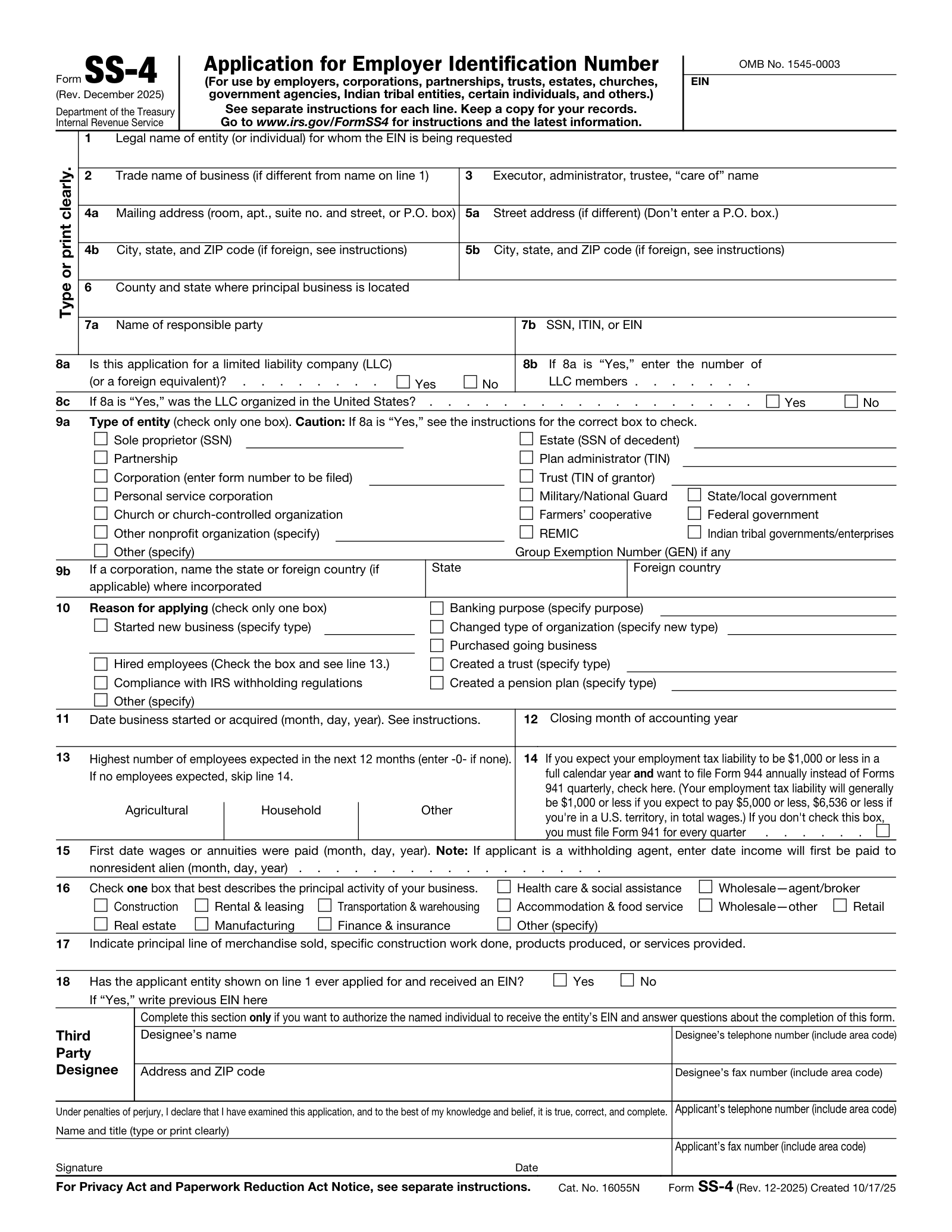
Official form (IRS.gov): Form SS-4 official PDF
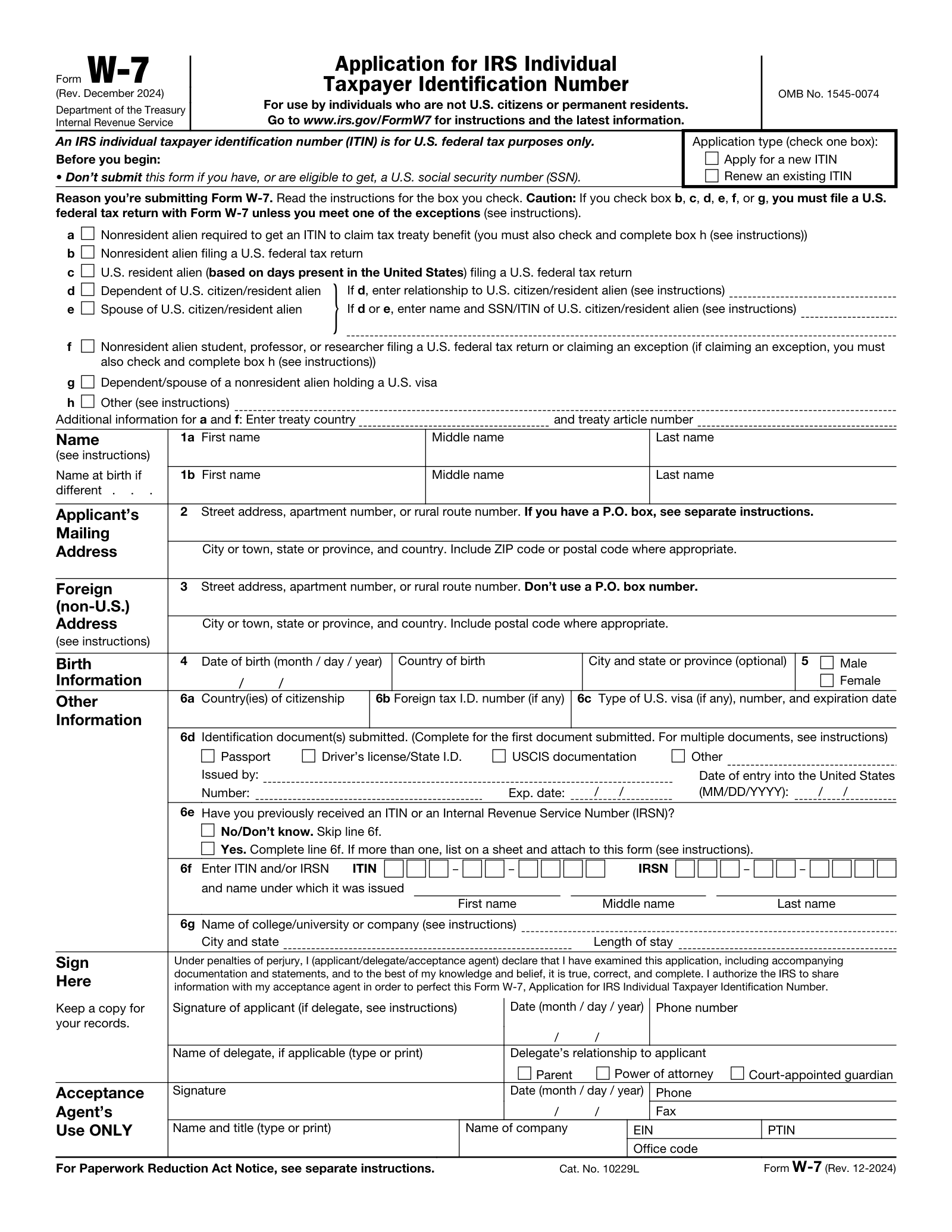
Official form (IRS.gov): Form W-7 official PDF
Here is the confusion to kill early: you usually do not need an ITIN to own an LLC or open a business bank account. You need an EIN. An ITIN is for personal US tax filing or certain US-source income. Paying $300 for an ITIN you never needed is one of the most common wasted costs.
For the EIN, you file Form SS-4, mark the responsible party section correctly, and send it by fax or mail. Note: manual IRS processing for foreign applicants can take weeks, not days.
For the ITIN, two routes. Mail your original passport to the IRS - free but slow and you lose the passport for weeks. Or use a Certifying Acceptance Agent who verifies your documents and sends the W-7 for you - typically $200-$400.
If you want help with getting an EIN as a non-US resident, that is a separate, free-from-the-IRS step - never pay a provider for the EIN itself.
What do a registered agent, US address, and phone number cost?
Budget $50-$300 per year for a registered agent, $0-$300 per year for a US business address, and $0-$200 per year for a US phone number.
A registered agent is a person or company physically present in the state who accepts legal documents on your behalf. Every state requires one. You cannot use a PO box, and using your own Indian address is generally not allowed.
Heads-up on the bundle trap: many formation services include a "free" registered agent for year one, then auto-renew at $100-$300. Read the renewal price before you buy, not after.
A virtual US address and a registered agent address are often two different products. You may need both - one for mail and banking, one for legal service. If you plan to open a US account, a US business bank account setup usually starts with a real US address and phone number.
How much does US banking and payment setup cost a non-resident?
Opening a business bank account is often $0 in monthly fees at Mercury or Wise Business, but approval is discretionary and some Indian founders are declined. Budget for alternatives and for per-transaction FX and payout fees.
| Option | Cost structure | Reality for Indian founders |
|---|---|---|
| Mercury | No monthly fee | Needs EIN + US address; approval discretionary |
| Wise Business | Setup fee varies | Strong for INR/USD movement |
| Payoneer | Per-transaction fees | Widely used, fee per payout |
| Stripe | ~2.9% + $0.30 per charge | Payment processing, not a bank |
| Traditional US banks | Monthly fees vary | Usually need US presence |
Two honest points. First, Mercury, Wise, Payoneer and Stripe are not banks in the traditional sense, and funds may not be FDIC-insured - check current terms. Second, no provider guarantees approval. An LLC may make you eligible to apply; the decision stays with the provider.
If remote options decline you, a brick-and-mortar route exists but usually needs US presence. See in-person US bank account help if that becomes your path.
What are the annual compliance costs an Indian founder must budget for?
Plan for $500-$1,500+ per year: registered agent renewal, state annual report or franchise tax, and CPA fees to file Form 5472 + pro forma 1120. The federal forms are free, but the penalty for not filing is $25,000.
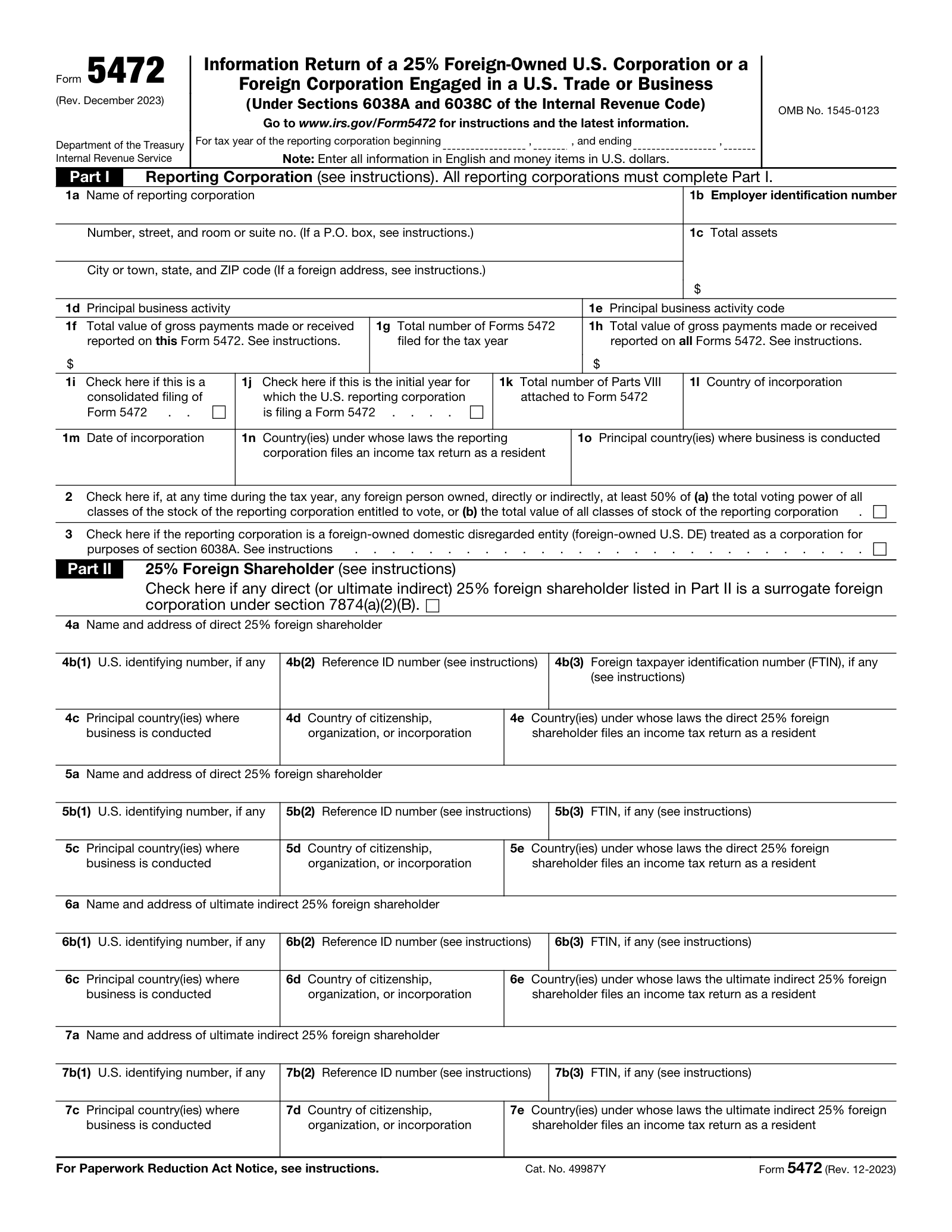
Official form (IRS.gov): Form 5472 official PDF
For a foreign-owned single-member LLC, you file Form 5472 attached to a pro forma Form 1120. Due with the tax return - generally April 15, or June 15 with an extension. Miss it and the IRS can assess a $25,000 automatic penalty.
State deadlines matter too. Wyoming's minimum annual license tax is about $60. Delaware's LLC franchise tax is $300. Texas has a franchise tax. New Mexico has no annual report.
A C-corp changes the picture: Form 1120, potential 21% federal corporate tax, a Delaware franchise tax calculated differently, and 83(b) elections for founders. If you are raising US venture capital, that is the structure - but it costs more to run.
Indian-side costs exist too. Tax residency, FEMA/ODI rules, and GST on exports can add obligations. For the US filings, a federal tax support service can handle Form 5472 and Form 1120.
What is the total first-year budget, and where can an Indian founder save?
A lean Wyoming LLC year one is roughly $500-$900 all-in. A Delaware C-corp targeting US VC is more like $1,500-$3,000+ once you add franchise tax, CPA, and banking setup.
| Item | Low | High |
|---|---|---|
| State filing fee (government) | $50 | $300 |
| Registered agent (year 1) | $0 | $300 |
| US address + phone | $0 | $500 |
| EIN | $0 | $0 |
| ITIN (only if needed) | $0 | $400 |
| CPA for 5472 + 1120 | $300 | $800 |
| State annual report/franchise | $60 | $300 |
| Banking/payment fees | $0 | $300 |
| Total | ~$410 | ~$2,900 |
Where to save:
- File directly with the state to skip provider markup.
- Get the EIN yourself - it is free.
- Use a CAA only if you truly need an ITIN.
- Avoid California unless you must - the $800 minimum franchise tax applies regardless of revenue.
- Cancel or renegotiate any "free" agent bundle before it renews.
Hidden costs to watch: foreign qualification in a second state, sales tax registration, and forex/FIRC charges when wiring money from India.
What does a US LLC actually cost an Indian founder in year one?
Plan on $1,000 to $2,500 (roughly Rs 85,000 to Rs 2.2 lakh) for a realistic first year, not the $100 headline you see in ads. The bare government filing is genuinely cheap. Everything that makes the LLC usable from India is not.
Quick Answer: A US LLC for an Indian founder costs about $100 to $300 in state filing fees, plus $50 to $300 for a registered agent, $0 to $300 for EIN help, $0 to $500 for ITIN support and $300 to $1,000 for the annual Form 5472 filing. A lean setup lands near $700 to $1,000 in year one. A Stripe-ready setup with a CPA lands near $1,200 to $1,800.
Three buckets keep this honest. Government fees are unavoidable and fixed by statute. Provider fees are shoppable, and you can do most of the work yourself. Recurring compliance costs come back every year whether you earn a rupee or not.
Every INR figure below uses Rs 85 to Rs 88 per USD, a planning band for 2026, not a live quote. Check the rate on the day you pay. A 5% rupee move shifts a Rs 1.5 lakh budget by Rs 7,500.
The cheapest formation is not the cheapest company. A state that charges nothing to file but bills a large annual report costs more by year three than one that charges $100 upfront. You will meet that trade-off again in the state table below.
If you have not picked a state yet, start with US LLC formation for non-residents before you compare prices, because the state choice sets your recurring bill.
Which state fees are unavoidable, and which states are cheapest for Indian founders?
The state filing fee is the only truly mandatory formation cost, and it runs from about $50 to $500 depending on the state. Wyoming and Delaware are the two most common picks for foreign-owned LLCs, for different reasons.
| State | Formation fee (USD) | Approx. INR | Annual report / franchise tax | What it means for you |
|---|---|---|---|---|
| Wyoming | About $100 | Rs 8,500 to 8,800 | About $60 minimum | Low recurring cost, strong privacy, popular with solo founders |
| Delaware | About $110 | Rs 9,400 to 9,700 | About $300 franchise tax | Higher yearly bill, chosen when you plan to raise venture money |
| New Mexico | About $50 | Rs 4,300 to 4,400 | No annual report | Cheapest to start, thinner support ecosystem |
| Florida | Check the current official fee | Varies | Annual report required | Useful if you have a real US presence there |
| Colorado | Check the current official fee | Varies | Annual report required | Middle ground on cost |
Verify every number in that table against the state Secretary of State fee schedule before you file. Fees change, and a stale blog post is a bad reason to overpay.
Delaware costs more every year, and that is the point. Investors and their lawyers expect a Delaware entity, so you pay the franchise tax for familiarity. Wyoming suits a solo Indian founder selling software or services: low annual cost, no state income tax, and a filing system that works entirely online.
A registered agent is the person or company with a physical US street address who accepts legal mail for your LLC. Every state requires one. It is a separate line item, roughly $50 to $300 a year, and it is not part of the state fee. Do not use a friend's apartment address. You lose privacy, and you lose mail when they move.
Do Indian founders pay for an EIN, and when do you also need an ITIN?
The EIN is free from the IRS. The ITIN is also free from the IRS. What you pay for is convenience, error-checking and passport handling.
An EIN (Employer Identification Number) is your LLC's federal tax ID, the number banks and Stripe ask for first. You get it by filing Form SS-4 by fax or phone as an international applicant. The IRS charges nothing.
Most Indian founders still pay a provider $50 to $300. The fax line is slow, the form has a dozen fields that are easy to fill wrong as a non-resident, and a rejected SS-4 means starting over. That fee buys speed and a second pair of eyes, not the number.
An ITIN is different. It is a personal tax ID for you as an individual, issued on Form W-7, and you need it only when you file a US return or claim treaty benefits. It is the single most conflated pair in Indian-founder content. Your LLC's EIN does not give you an ITIN, and an ITIN does not replace the EIN.
To get an ITIN you send Form W-7 with a certified copy of your passport. Certification comes from the issuing agency or a Certified Acceptance Agent (CAA). CAAs charge roughly $200 to $500 for the service. IRS processing runs about 7 to 11 weeks, longer in peak season.
| Item | IRS fee | Typical provider fee | INR equivalent of provider fee |
|---|---|---|---|
| EIN (Form SS-4) | $0 | $50 to $300 | Rs 4,300 to 26,400 |
| ITIN (Form W-7 via CAA) | $0 | $200 to $500 | Rs 17,000 to 44,000 |
Skip the ITIN in month one. Most fintech banks and Stripe accept the LLC's EIN plus your passport. Buy the ITIN when tax season arrives, and put that money into banking and compliance instead. If you want the paperwork handled, getting an EIN as a non-US resident covers the SS-4 route end to end.
What does US business banking and Stripe setup really cost from India?
Opening a US business bank account usually costs $0 upfront. Running it does not. Monthly maintenance runs $0 to $25, minimum balances run $0 to $2,000, and international wires cost roughly $15 to $45 each way.
Stripe charges no setup fee. It takes a cut of each transaction, around 2.9% plus $0.30 on a US account. On $5,000 of monthly revenue that is real money, and it belongs in your budget as a percentage, not a one-time cost.
| Option | Setup cost | Monthly fee | Minimum balance | Notes for Indian-resident owners |
|---|---|---|---|---|
| Mercury | $0 | $0 | $0 | Fintech account, online application, popular with startups |
| Wise Business | $0 | $0 | $0 | Strong multi-currency and INR transfer routes |
| Payoneer | $0 | $0 | $0 | Works well for marketplace payouts |
| Brex | $0 | Check current plan terms | Check current plan terms | Oriented toward funded startups |
| Traditional US bank | $0 to $100 | $10 to $25 | $1,500 to $2,000 | Usually needs a US visit or a strong referral |
Those cells are starting points, not quotes. Provider fee schedules change, and eligibility rules for Indian-resident owners change faster. Read the provider's own pricing page on the day you apply.
Say your Stripe application gets declined in week three. You have already told clients you accept cards. The fix is a second processor, a clean business description and a US address that matches your filings, and it costs you two to four weeks of selling time. Budget for a fallback before you need one.
Approval is never guaranteed. No bank and no processor owes you an account. A US LLC with an EIN makes you eligible to apply. The decision stays with the provider.
Getting money home is its own line. Wire fees, the FX spread and your Indian bank's inward remittance charges add up on every transfer. If you invoice US clients from an Indian entity instead, GST on export of services and FEMA reporting rules apply, and your CA will charge for that work.
Which fees come back every year, whether or not you earn anything?
Registered agent, state annual report, a US address and the federal Form 5472 filing. Miss the last one and the penalty is $25,000.
| Recurring item | Frequency | USD | Approx. INR | Unavoidable? |
|---|---|---|---|---|
| Registered agent | Annual | $50 to $300 | Rs 4,300 to 26,400 | Yes |
| State annual report / franchise tax | Annual | $0 to $300+ | Rs 0 to 26,400+ | Yes |
| US address and mail forwarding | Annual | $100 to $300 | Rs 8,500 to 26,400 | Practically yes |
| Form 5472 + pro forma Form 1120 | Annual | $300 to $1,000 (CPA) | Rs 26,400 to 88,000 | Yes, filing itself |
| Bookkeeping | Monthly or annual | Varies | Varies | Optional, wise |
A foreign-owned single-member LLC files Form 5472 with a pro forma Form 1120 every year. It is an information return, not a tax payment. The LLC discloses its reportable transactions with the foreign owner. File nothing and the IRS can assess $25,000 per form per year, with more for continued failure. That applies even if the LLC earned zero.
On income: a single-member LLC owned by a non-resident with no US-source effectively connected income owes no US federal income tax. That is not the same as owing nothing anywhere. State-level taxes, sales-tax nexus and your Indian tax position under DTAA rules all depend on your facts. Talk to a cross-border CPA before you assume anything.
Suppose your LLC takes $40,000 in year one and you skip the 5472 because the money came from clients outside the US. The penalty exposure is $25,000 against a $300 to $1,000 CPA bill. Do the math once and the DIY temptation disappears.
What hidden costs do Indian founders only discover after forming the LLC?
The surprises are mail forwarding, a US phone number, sales-tax registration, bookkeeping, and the India-side CA bill for ODI, FEMA and GST work.
- Mail forwarding and a US number: $100 to $300 a year. Verification codes and bank letters arrive by post and phone.
- State sales-tax registration: required once you cross a state's economic nexus threshold. Compliance software or a preparer costs money per state.
- Bookkeeping: $50 to $200 a month if you outsource it. Cheaper than fixing a year of mess in April.
- India-side CA work: FEMA and ODI reporting for outbound investment, GST filings on export of services, and DTAA documentation. Ask your CA for a quote in rupees before you form anything.
- TDS on cross-border payments: if you pay US contractors or services, withholding rules apply and someone has to track them.
- Fixing a rejected application: two to four weeks of lost selling time, plus any re-application fees.
Imagine you form the LLC, land three US clients, and only in month eight learn that your Indian CA wants extra for ODI reporting on the outbound investment. That is a real rupee cost you did not budget. Ask the question before you file, not after.
What is a realistic total first-year budget for an Indian founder?
Three scenarios, same line items, so you can swap in your own state and provider.
| Line item | Lean solo | Stripe-ready | Fully managed |
|---|---|---|---|
| State filing fee | $100 | $100 | $110 |
| Registered agent (year 1) | $50 | $150 | $300 |
| EIN | $0 (self-filed) | $150 | $300 |
| ITIN | $0 (deferred) | $0 (deferred) | $400 |
| US address / mail | $0 | $100 | $200 |
| Banking | $0 | $0 | $25/month |
| Form 5472 + 1120 (CPA) | $0 (DIY) | $400 | $800 |
| Bookkeeping | $0 | $600 | $1,200 |
| Year-one total (USD) | $150 to $300 | $1,500 to $1,800 | $3,300 to $3,600 |
| Year-one total (INR) | Rs 13,000 to 26,000 | Rs 1.3 to 1.6 lakh | Rs 2.8 to 3.2 lakh |
| Year-two total (USD) | $60 to $150 | $1,250 to $1,550 | $2,900 to $3,200 |
Year two drops the state filing fee and the ITIN. Everything else recurs. That is why the lean column looks so attractive and why the Stripe-ready column is the one most founders actually need.
A decision rule that saves people money: if your expected annual profit from the LLC is under about $5,000, the compliance overhead eats a large share of it. Sell as an Indian proprietorship first, prove demand, then form the US LLC when the revenue justifies the fixed cost.
Be blunt with yourself about which column you are in. Do not buy the fully managed package to feel safe. Buy the Stripe-ready column, self-file the EIN if you are comfortable with Form SS-4, and spend the savings on a CPA who knows Form 5472.
Next step
The number that matters is not the $100 filing fee. It is the recurring annual bill, and you can price it today: pick your state, add the agent, the address and the 5472 filing, and see whether your expected revenue clears it. If it does, form the LLC and stop deliberating. If it does not, wait a year and keep selling.
When you are ready to move, NexFyla helps non-US founders form US companies and set up EIN and US business banking support, so the paperwork does not eat your first month of selling. You can also compare NexFyla pricing against the budget above before you decide.
*Last updated: February 2026.*
Related reading
- US Company Registration for Non-Residents: What to Prepare
- Foreign Company Registration in the US: Two Paths
- What a US LLC Really Costs a Non-Resident Founder
Ready to act on this? US company formation takes the filing, registered agent and paperwork off your desk.
About the author
Ashwini Dhangar is a Senior Corporate Structuring Specialist and US company formation advisor at NexFyla. She works with non-resident founders on LLC formation, EIN and ITIN filings, and US business banking — and has handled these filings for founders across India, the UK and the Gulf. More about the team · LinkedIn