Table of Contents
▼
What is the difference between an EIN and an ITIN?
An EIN is a business tax ID the IRS issues to an entity like an LLC or corporation. An ITIN is a personal tax ID the IRS issues to an individual who needs to file US taxes but cannot get a Social Security number (SSN).
Both are types of Taxpayer Identification Number (TIN), the umbrella term for the numbers the IRS uses to administer tax law [1]. Other TINs include the SSN and the PTIN for tax preparers. Your situation decides which one you need.
The clean split: an EIN identifies your company. An ITIN identifies you as a person on a personal return. A non-resident founder running a US LLC will usually need the EIN first, and may need an ITIN later for personal filings.
Here is the comparison that matters when you are choosing what to apply for.
| EIN | ITIN | |
|---|---|---|
| Issued to | Business entities (LLC, corporation, partnership) | Individuals only |
| Who applies | The entity, through a responsible party | The individual |
| Form | Form SS-4 | Form W-7 |
| SSN required | No | No (that is the point) |
| Work authorization | No | No |
| Typical first use | Opening a bank account, filing business returns | Filing a personal US tax return |
Neither number gives you immigration status or the right to work in the US. They are tax processing numbers, nothing more.
When does a non-resident need an EIN for an LLC?
You need an EIN when you form a US LLC and want to operate it as a business: open a US bank account, process payments through a provider, hire staff, or file the returns a foreign-owned LLC owes. In practice, almost every non-resident founder needs one at formation.
The reason is administrative, not philosophical. A single-member LLC owned by a non-resident is a disregarded entity for US tax purposes, meaning the IRS ignores the LLC as a separate taxpayer. That does not make the filing obligation disappear. The LLC must file Form 5472 (information about transactions with foreign related parties) attached to a pro forma Form 1120, and that filing requires an EIN.
Say your LLC is formed in Wyoming and you live in Pune. You have not earned a dollar yet. You still file Form 5472 with the pro forma 1120 for the tax year, and you cannot do it without an EIN. The penalty for missing that filing is steep, so the EIN is not optional paperwork you get to later.
Banks and payment processors also treat the EIN as the entry ticket. Mercury, Wise Business, Stripe and the rest ask for it during onboarding. Approval stays their decision, but without an EIN you cannot even start the application.
If you are forming the company now, US LLC formation for non-residents covers the entity side, and getting an EIN as a non-US resident covers the number itself.
When does a non-resident need an ITIN?
You need an ITIN when you have a US tax filing requirement as an individual and you are not eligible for an SSN. The IRS issues it to people filing a return who are not US citizens and do not have, or cannot get, a Social Security number [3].
Owning a US LLC by itself does not trigger an ITIN. This is where most guides go wrong. The LLC's filing (Form 5472 and the pro forma 1120) is a business filing, and the EIN covers it. Your personal ITIN becomes relevant when you personally have something to report.
Examples that create a personal filing requirement:
- You receive US-source income such as dividends, royalties or interest that is reportable.
- You elect to file a joint return with a US citizen or resident spouse.
- A US payer or withholding agent needs your US TIN on a form [4].
- You are claiming a refund of US tax withheld.
An ITIN application is tied to a filing requirement. The US embassy guidance is blunt on this: you must have a filing requirement and file a valid federal return to receive an ITIN, unless you meet a specific exception [9]. You do not apply for an ITIN as a general-purpose ID card for later.
Can you apply for an EIN without an SSN?
Yes. A non-resident can get an EIN without an SSN or ITIN, and without ever setting foot in the US. The route is Form SS-4, the application for an Employer Identification Number.
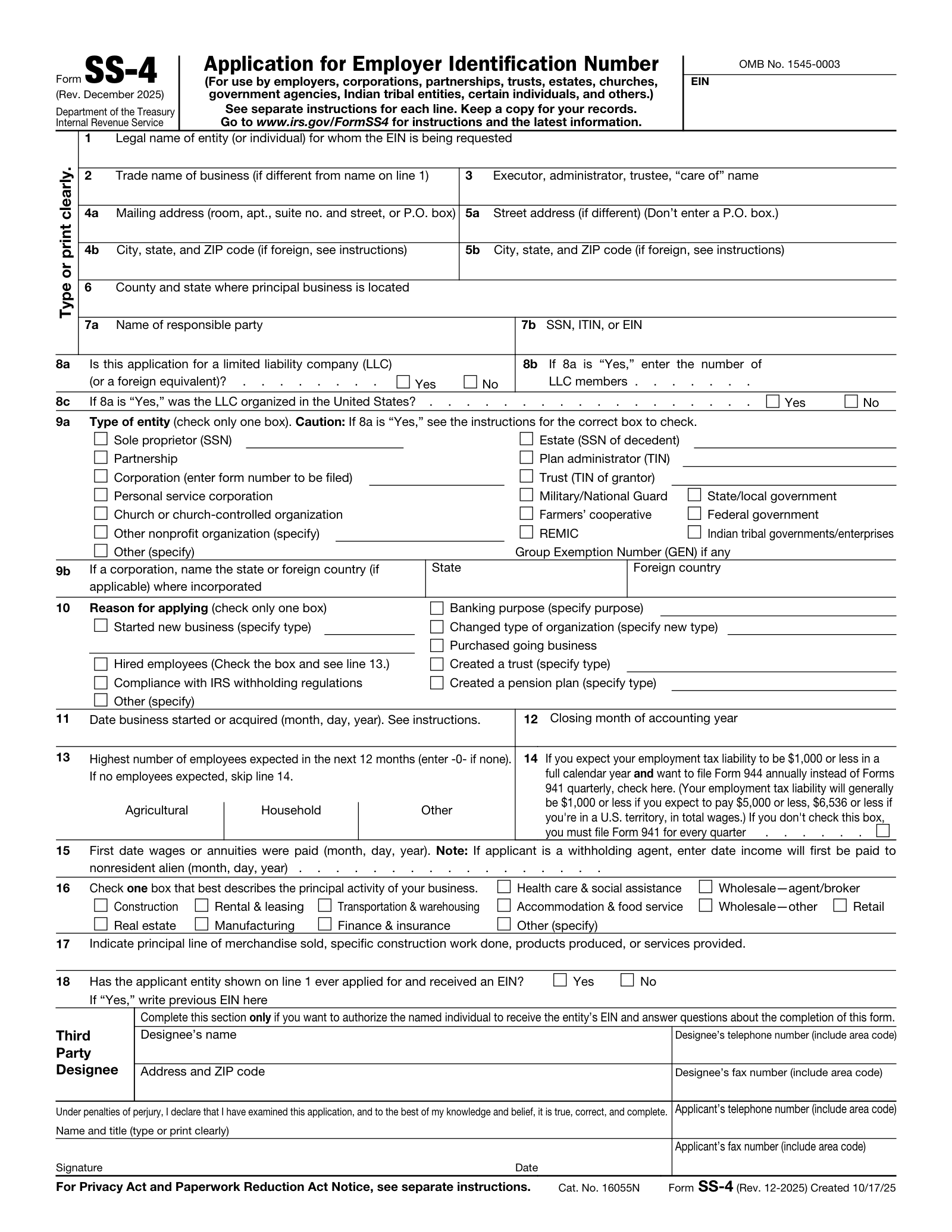
Official form (IRS.gov): Form SS-4 official PDF
The online EIN application is fast and free, but it is built for applicants with a valid SSN or ITIN. Non-residents without either number use the paper form and submit it by fax or mail. Stripe's own resource page confirms nonresidents can obtain an EIN while living outside the US without an SSN or ITIN [5].
The mechanics:
- Complete Form SS-4. Leave the SSN/ITIN field blank if you do not have one. The responsible party (the person who controls the entity) can be a non-resident individual.
- Fax the form to the IRS international line. Fax is faster than mail and the IRS can return the EIN by fax.
- Wait for the fax or letter with your EIN. Timelines vary with IRS workload;
Tip: write your fax number clearly on the form. A wrong digit means the EIN goes nowhere and you restart the clock.
How to apply for an ITIN as a non-resident
You apply for an ITIN with Form W-7, the Application for IRS Individual Taxpayer Identification Number, plus supporting identification documents. There are three submission routes: mail, in person at an IRS Taxpayer Assistance Center, or through a Certifying Acceptance Agent (CAA), a professional authorized to verify your documents so you do not mail originals [3].
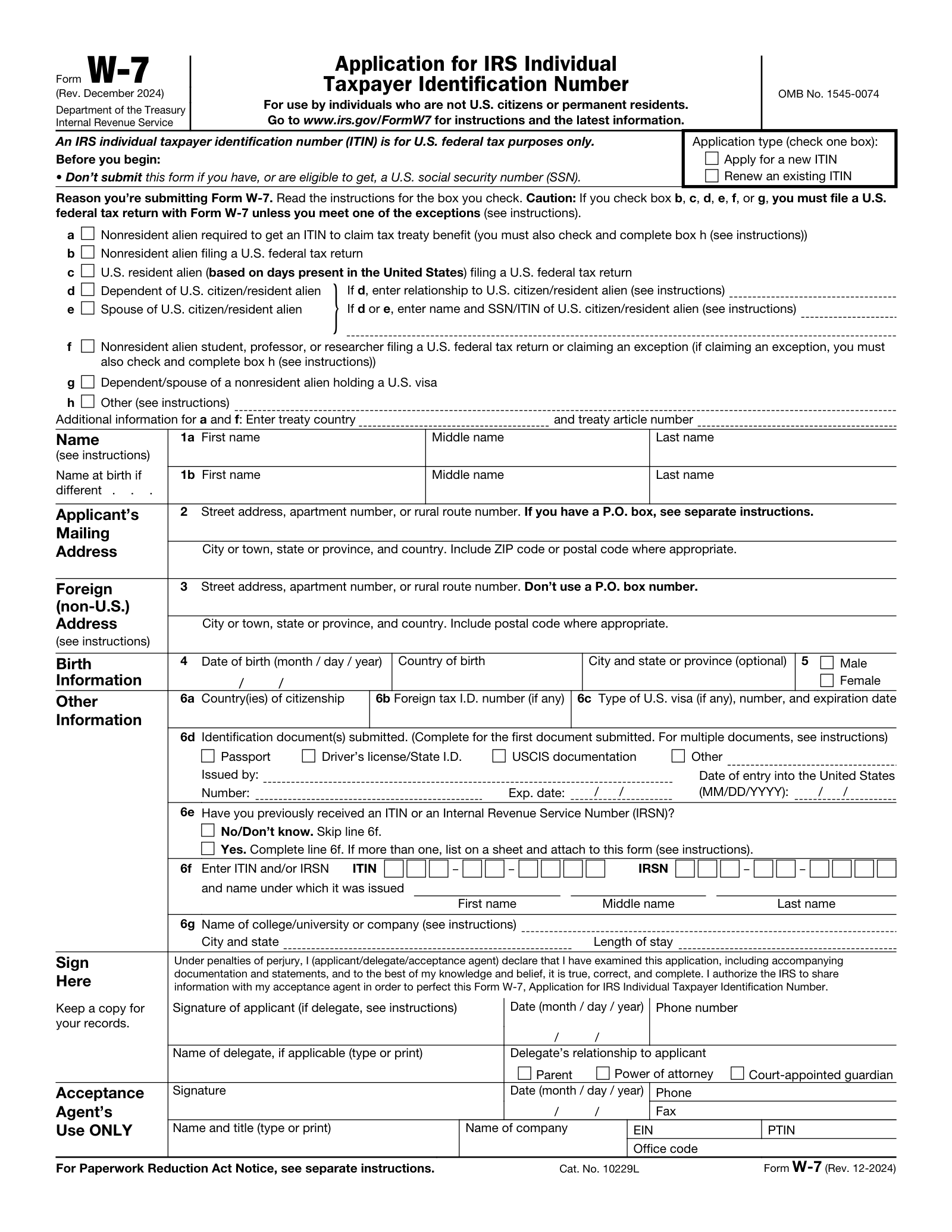
Official form (IRS.gov): Form W-7 official PDF
The document requirement is the part people underestimate. The IRS wants original documents or certified copies, and it returns originals after processing. If you mail your passport from India to the US, you are without a passport for weeks or months. That is the practical reason most non-residents use a CAA.
Suppose you are a founder in Bengaluru who needs an ITIN because you are filing a personal return to claim withheld tax. You fill out W-7, attach your passport, and mail it. Your passport sits in an IRS mailroom. If you have travel booked, you have a problem. The CAA route exists precisely to avoid that.
Heads-up: the IRS controls processing time, not your agent. A CAA verifies documents faster; it does not speed up the IRS queue. Plan for weeks, not days, and build the timeline around your filing deadline
For the application itself, how to apply for an ITIN walks through Form W-7 and the document checklist.
Common mistakes when applying for a tax ID
Most delays come from four specific errors, not from the IRS being slow.
Applying for an ITIN when only an EIN is needed. If you own an LLC and have no personal US filing requirement, you do not need an ITIN yet. Applying anyway wastes months and documents.
Assuming you need an SSN to get an EIN. You do not. The SS-4 route exists for exactly this case. Founders who believe otherwise stall for weeks trying to solve a problem that is not real.
Sending original documents without tracking. If your passport goes missing in the mail, replacing it is your problem, not the IRS's. Use tracked mail or a CAA.
Using a foreign TIN where a US TIN is required. Your PAN or Aadhaar-linked tax number is a foreign TIN. It belongs on Form W-8BEN for treaty benefits, not as a substitute for an EIN or ITIN on a US return. The two are different fields on different forms.
One more: name mismatches. The name on your SS-4, your LLC's Articles of Organization, and your bank application must match. A middle name dropped in one place and present in another triggers a rejection that costs you a week.
Do you need a tax ID to open a US bank account?
Yes. Most US banks require an EIN to open a business account, and fintechs like Mercury and Wise ask for it during onboarding. Banks operate under KYC and anti-money-laundering rules and must identify both the business and its owners.
An ITIN for the individual signer is a different question. Some banks ask for it; many accept a passport and proof of address instead. Policies vary by institution, and approval is always the bank's decision. Do not assume an ITIN guarantees an account, and do not assume you need one to apply.
If you are comparing routes, opening a US business bank account covers the online and fintech path, and in-person US bank account help covers the branch route.
How NexFyla can help with EIN and ITIN applications
NexFyla helps non-US founders form US companies and set up EIN and US business banking support. That includes preparing and submitting Form SS-4, reviewing W-7 documentation, and coordinating with a Certifying Acceptance Agent where one is needed.
We do not guarantee approval. The IRS decides, and processing time is theirs. What we do is reduce the errors that cause rejections: wrong form, blank fields that should be filled, name mismatches, missing documents.
If you are unsure whether you need an EIN, an ITIN, or both, that is the first question to settle. It depends on your entity structure and what income you actually have. Federal tax support for Form 5472 and Form 1120 covers the filing side once the numbers are in place.
Frequently Asked Questions
Can I get an EIN without an SSN or ITIN? Yes. File Form SS-4 by fax or mail. The online application requires an SSN or ITIN, but non-residents use the paper form.
Do I need an ITIN to open a US bank account? Not always. Most banks require an EIN for the business. An ITIN for the signer may be requested but is not universally mandatory. Policies vary.
How long does it take to get an ITIN? Processing takes weeks to months. A Certifying Acceptance Agent speeds up document verification, not IRS processing.
Can I use my foreign tax ID instead of an ITIN? No. A foreign TIN is for your home country. US filings require a US TIN, either an EIN or an ITIN.
Does an ITIN allow me to work in the US? No. An ITIN is a tax processing number. It does not authorize work or provide immigration status.
What is the difference between an EIN and a TIN? A TIN is the umbrella term. An EIN is a TIN for businesses; an ITIN is a TIN for individuals.
*Last updated: February 2026.*
What is the actual difference between an EIN and an ITIN?
An EIN identifies your business. An ITIN identifies you, personally, when you have a US tax filing obligation but cannot get a Social Security number. That is the whole rule. Everything else follows from it.
Both are TINs. A Taxpayer Identification Number is the umbrella term the IRS uses for any number it or the Social Security Administration issues to administer tax law [1]. Under that umbrella sit the SSN, the EIN and the ITIN. Same family. Different owners.
Here is the split, side by side:
| EIN | ITIN | |
|---|---|---|
| Belongs to | A business entity (LLC, corporation, partnership) | An individual person |
| Issued by | IRS | IRS |
| Application form | Form SS-4 | Form W-7 |
| Format | 9 digits, usually XX-XXXXXXX | 9 digits, starts with 9 |
| Needed when | Your entity has US filing or reporting duties | You personally file a US return or claim a treaty benefit |
| Cost from the IRS | $0 | $0 |
The conflation is the single most common mistake I see. Founders apply for an ITIN because a blog told them they need a "US tax ID," then discover their LLC still has no EIN and no way to file. Or they get an EIN and assume it covers their personal return. It does not. One number per taxpayer, and your LLC is a separate taxpayer from you.
Which tax ID does your LLC or corporation actually need?
The company needs an EIN. Always. Even a single-member LLC with no US employees, no US office and no US bank account.
The reason is not employees. It is paperwork. A foreign-owned single-member LLC treated as a disregarded entity still has to file Form 5472 each year, attached to a pro forma Form 1120. That form reports transactions between the LLC and its foreign owner, and it needs the entity's EIN to be filed at all. Skip it and the penalty is real money.
There is a second reason. Anyone who pays your LLC, or opens an account for it, asks for a W-8BEN-E, the withholding certificate for foreign entities. That form wants the entity's EIN. No EIN, no form, no payment.
Suppose you form a Wyoming LLC in January and take your first US client in March. The client's AP team asks for a W-8BEN-E before releasing payment. You cannot complete it without an EIN, so the invoice sits unpaid until the IRS mails your number. Get the EIN before you go looking for customers.
| Entity type | Entity needs | Owner may separately need |
|---|---|---|
| Single-member LLC (foreign owner, disregarded) | EIN | ITIN only if personally filing |
| Multi-member LLC | EIN | ITIN if the owner is a partner with a personal filing duty |
| C-corporation | EIN | ITIN only if personally filing |
| Your personal tax return | Nothing | ITIN (or SSN) |
One line on Form SS-4 stops people cold: the Responsible Party. That is the human being who controls the entity, and a foreign individual with no SSN and no ITIN can be listed there. You do not need an ITIN to get an EIN. If you want the entity side handled end to end, US LLC formation for non-residents covers the formation and the SS-4 together.
When does an individual non-resident need an ITIN instead?
Only when you personally have a US federal tax filing or reporting obligation and you are not eligible for an SSN. The IRS issues an ITIN to people filing a US return who are not US citizens and do not have, or cannot get, a Social Security number [3].
The triggers are specific:
- You file a US federal return, for any reason.
- You are claimed as a dependent on someone else's US return.
- You need to claim a treaty benefit on your own behalf.
- You receive US-source income that gets reported on your personal return, such as royalties or interest.
- You are a partner or member with a personal filing requirement flowing through to you.
- You are filing to claim a refund of US tax withheld.
Now the other column. Owning a foreign-owned LLC that files its own returns does not require an ITIN. Opening a US business bank account does not require an ITIN. Getting paid by US customers through your LLC does not require an ITIN. In each case the EIN plus a W-8BEN-E does the work.
An ITIN is for tax administration. It does not change your immigration status, does not authorize you to work in the US, and does not make you a resident for tax purposes [2].
How do you apply for an EIN as a foreign person?
File Form SS-4 by fax, phone or mail. The online EIN assistant requires an SSN or ITIN, so most non-residents cannot use it [5][6].
The IRS issues EINs free, directly, and the online route is instant for people who qualify [4]. You probably do not qualify. Plan for the paper routes.
Official form (IRS.gov): Form SS-4 official PDF
Fields that trip people up:
- Line 7a, Responsible Party. Your full legal name exactly as it appears on your passport. No nominee games, no friend's name.
- Line 8a, entity type. Check the box that matches what you actually formed, not what you wish you had formed.
- Line 9, reason for applying. "Started new business" is the usual answer for a fresh LLC.
- Line 7b, SSN/ITIN. Leave it blank if you have neither. The IRS accepts a foreign responsible party without one.
- Third Party Designee. Skip it unless someone is actually handling the filing for you.
Phone is fastest for most international applicants. The IRS publishes a dedicated international applicant line, and you should pull the current number from IRS.gov rather than from any blog, including this one Fax is next. Mail is slowest and the only route that gives you a written trail by default.
Heads-up: the IRS charges nothing for an EIN. If a site quotes you a fee for "the EIN application," you are looking at a service fee, not a government fee. Pay it if you want someone else to sit on hold. Do not confuse it with tax.
How does the ITIN application work from abroad?
File Form W-7 by mail with a valid federal tax return attached, plus original documents or certified copies from the issuing agency. The IRS is explicit that mailed W-7 applications from abroad must carry original documents or certified copies, not photocopies [8].
There are three routes [3]:
- Mail. Form W-7, your federal return, and your passport or other identity documents. Original or agency-certified. The IRS returns originals, but you are without your passport for weeks.
- Certifying Acceptance Agent. A CAA verifies your documents and sends certified copies, so you keep your passport. The IRS does not charge for this. The CAA charges you a service fee.
- IRS Taxpayer Assistance Center. In person, in the US. Not practical from India unless you happen to be traveling.
Official form (IRS.gov): Form W-7 official PDF
Processing takes weeks, not days, and it runs from the date the IRS receives a complete application.
Imagine you file your first US return in March and mail your passport with the W-7. The return is due 15 April. If the package is incomplete, the IRS sends it back and you have lost weeks. Use a CAA if you need your passport for travel in that window.
The renewal rule catches people who stop filing. An ITIN that goes unused on a federal return for three consecutive years expires and must be renewed [2]. If you got an ITIN in 2022, skipped 2023 through 2025, and now need to file, check its status before you assume it works.
Do you need both, and in what order should you apply?
Most foreign founders need only the EIN. Get the EIN first, and add an ITIN only when a personal US filing obligation appears.
The sequence:
- Form the entity.
- File Form SS-4 for the EIN.
- Open banking and payments using the EIN and a W-8BEN-E.
- Assess whether you personally have a US filing duty.
- File Form W-7 only if step 4 says yes.
An ITIN can go on Form SS-4 as the responsible party's ID if you already hold one. It is not required to get an EIN, and getting the EIN first does not block an ITIN later. The two numbers do not substitute for each other: an EIN will not work on your personal 1040-NR, and an ITIN will not satisfy your LLC's Form 5472 obligation.
Say your LLC starts paying you US-source royalties in 2026. That is the moment to look at a W-7, because withholding applies and a treaty claim needs your ITIN on the form. Until then, the EIN was enough.
For the banking step, opening a US business bank account walks through what providers ask for and why the EIN is the first thing they request.
What each ID does and does not authorize
Neither number grants immigration status, work authorization or a bank account. They are tax identifiers.
An EIN lets your business file returns, set up payroll if you hire, and complete counterparty forms. US payers ask for a W-9, which needs the EIN. Foreign entities receiving US-source income complete a W-8BEN-E, which also needs the EIN. An EIN does not make your company US-resident for tax purposes and creates no visa path.
An ITIN lets you file a personal US return and claim treaty benefits. It does not authorize work, does not make you eligible for an SSN, and does not establish US residency [2].
The W-8BEN versus W-8BEN-E split follows the same logic. Individuals file W-8BEN. Entities file W-8BEN-E. Get the wrong one and the payer rejects it.
The short version
Get the EIN. That is the number your LLC needs, and it is free, and you can apply without an SSN or ITIN. Add the ITIN later, and only when a personal US filing obligation actually exists. If you are unsure which one your situation calls for, ask a qualified tax professional before you mail a passport to the IRS.
NexFyla helps non-US founders form US companies and set up EIN and US business banking support. If you want help with US LLC formation, EIN and business setup, NexFyla can assist.
*Last updated: February 2026.*
What is a tax ID, and why does the US use more than one?
A tax ID is a Taxpayer Identification Number (TIN). The IRS uses several TIN types because it identifies businesses and individuals separately: an EIN for entities, an SSN for citizens and eligible workers, and an ITIN for individuals without an SSN who need to file a US return [1].
Quick Answer: A US tax ID is any TIN the IRS uses to identify a taxpayer. Your LLC gets an EIN (Employer Identification Number) from the IRS for free. You personally get an ITIN (Individual Taxpayer Identification Number) only if you have your own US filing obligation. They are two different numbers for two different taxpayers, and neither one replaces the other.
That mental model carries the rest of this article. One number identifies your company. Another number, if you ever need one, identifies you. They sit on different lines of different forms, and mixing them up is the single most common paperwork error I see from non-US founders.
The TIN family includes SSN, EIN, ITIN, ATIN and PTIN [1]. Only two matter to you: EIN and ITIN. An ITIN is a 9-digit number the IRS issues when you need a US taxpayer identification number but are not eligible for an SSN [2].
One formatting detail worth knowing: ITINs start with the digit 9, and the fourth digit is a 7 or 8.
EIN: who is it for and what does it cover?
An EIN is the IRS number for your LLC. It is free from the IRS and you request it on Form SS-4. It is the number your company uses for banking, payroll and tax filings.
Official form (IRS.gov): Form SS-4 official PDF
Who actually needs one:
- Multi-member LLCs, always.
- Any LLC opening a US business bank account, because banks run KYC on the entity and the EIN is the entity's identifier.
- Employers with US payroll.
- Foreign-owned single-member LLCs, which must file Form 5472 with a pro forma Form 1120 under that EIN.
Here is the part most guides bury: a non-resident does not need an SSN or ITIN to get an EIN [5]. The SS-4 asks for the responsible party's name and taxpayer ID, but a foreign founder without a US number can still apply. That is the whole reason the fax and mail routes exist.
Say your LLC is formed in Wyoming and you are in Pune. You fill out Form SS-4 with the LLC's name, your foreign address, and yourself as responsible party. You tick the box for the Third-Party Designee section if an agent is handling it, then fax it to the IRS international line. The EIN comes back by fax, and the CP 575 notice follows by mail.
On cost: the EIN itself is $0 from the IRS. Any fee you see is a provider or agent charge for handling the fax or the application, not a government fee.
If you are mapping the full sequence from state filing to bank account, the US LLC formation for non-residents path shows where the EIN step sits.
ITIN: who is it for and when is it actually required?
An ITIN is a personal number for an individual who has a US federal tax filing or reporting obligation and is not eligible for an SSN [2][3]. It is not a business number. It is not a work permit.
Official form (IRS.gov): Form W-7 official PDF
The trigger for a non-resident founder is narrow. You need an ITIN when you personally file a US return, for example a Form 1040-NR on US-source income, a treaty or withholding situation that requires your own number, or a refund claim [2]. Running an LLC is not, by itself, that trigger.
What an ITIN does not do:
- It does not authorize you to work in the US.
- It does not change your immigration status.
- It does not replace your LLC's EIN.
People without lawful status can obtain an ITIN, because the number exists for tax administration, not immigration [9]. Treat it as a filing tool, nothing more.
Application runs through Form W-7 with certified identification documents. There are three routes: mail, an IRS Taxpayer Assistance Center, or a certified acceptance agent [3].
Heads-up: ITINs expire after a period of non-use, and renewal means filing again.
Do you need an ITIN to form an LLC or open a bank account?
No. Forming an LLC is a state function and needs no IRS number at all. Opening a US business bank account needs the LLC's EIN, not your ITIN.
Break the myth into its parts:
- State formation: Articles of Organization and a state fee. No tax ID.
- EIN: the entity's number, from the IRS.
- Bank KYC: EIN, formation documents, your passport, proof of address.
- Personal filing: the only place an ITIN enters the picture.
What banks actually ask a non-resident owner for is the entity's EIN plus tax forms: W-8BEN-E for the entity and W-8BEN for the individual. Neither asks for a US ITIN. The W-8BEN asks for your foreign tax identifying number, meaning your home-country tax ID, which is a different thing [6].
Suppose a bank asks for your "tax ID" and you hand over an ITIN you happened to have. You have now told the bank an individual number belongs to an entity. That mismatch creates withholding and 1099 reconciliation problems later. Give the EIN where the entity is the payee.
| EIN | ITIN | |
|---|---|---|
| Identifies | Your LLC or business | You, personally |
| Issuing form | Form SS-4 | Form W-7 |
| IRS fee | $0 | $0 |
| Needed to form an LLC | No | No |
| Needed to open a US business bank account | Yes (the entity's) | No |
| Needed to file a personal US return | No | Yes |
The banking step itself has its own checklist, covered in opening a US business bank account as a non-resident.
How EIN and ITIN work together for a non-resident owner
They operate at two levels. The LLC files and reports under its EIN. Any personal US return you file uses your ITIN. Most founders only ever need the first one.
Walk the foreign-owned single-member LLC case. The LLC gets an EIN. Each year it files Form 5472 attached to a pro forma Form 1120, under that EIN. Your ITIN is not required for that filing. The form reports transactions between the LLC and its foreign owner, and the owner is identified by name and address, not by a US personal number.
When both numbers exist: you have US-source income or another personal filing obligation, so you get an ITIN alongside the LLC's EIN. Keep them on separate lines of every form. The entity's number never goes on your 1040-NR, and your ITIN never goes on the 5472 as the filer's EIN.
On classification: a single-member LLC owned by a non-resident is disregarded by default for US tax purposes, and Form 8832 is only relevant if you elect corporate treatment.
Imagine you take a US consulting client who pays your LLC. The client asks for a W-9. You are not a US person, so you do not give one. You provide a W-8BEN-E for the LLC instead, with the EIN on it. Your ITIN stays out of that exchange entirely.
Applying for each without a US address
Both numbers are obtainable from abroad. The EIN comes by fax or mail on Form SS-4, because the online EIN assistant is not open to applicants without an SSN or ITIN. The ITIN comes by mail or through a certified acceptance agent on Form W-7 [3][5].
EIN route: complete the SS-4, use your foreign address, and fax it to the IRS international line. Expect the EIN back by return fax. Keep the CP 575 notice. If you lose it, request a 147C letter, which is the IRS's replacement confirmation of your EIN.
ITIN route: W-7 plus your passport, either the original or a certified copy depending on the route. Do not mail your only passport.
Government versus provider cost, kept separate:
| Item | Who charges | Amount |
|---|---|---|
| EIN | IRS | $0 |
| ITIN | IRS | $0 |
| W-7 document certification | Acceptance agent or certifying office | Varies by provider |
| EIN fax or application handling | Agent service | Varies by provider |
| Registered agent, annual state fee | State and agent | Not a tax ID cost |
If the SS-4 comes back rejected, the usual cause is a missing or incomplete responsible party section. If a W-7 is rejected, it is almost always uncertified or missing identification documents. Fix the specific field and resubmit; do not start over.
Records to keep for both numbers
Keep three things: the IRS-issued notices, a one-page map of which number goes on which form, and a copy of every form you filed.
The map matters more than the notices. Which number on which form:
- Form SS-4: the entity. You are the responsible party, identified by name and address.
- Form W-9: only if you are a US person. Usually not you.
- Form W-8BEN: you, individually, with your foreign TIN.
- Form W-8BEN-E: the entity, with the EIN.
- Form 5472 and pro forma 1120: the entity's EIN.
- Form 1040-NR: your personal ITIN.
Store digital copies in one folder, note who the responsible party is, and update the IRS when the responsible party or address changes. If the CP 575 is lost, request a 147C letter.
Suppose you sell the LLC or bring in a co-owner. The new owner needs the EIN, the formation documents and the filing history. A folder with the CP 575, the 5472 filings and the number map makes that handover clean.
Which one do you need? Start with the EIN, because the LLC needs it for banking and for its annual 5472 filing. Add an ITIN only when you personally have a US return to file. If you want help with the entity side, getting an EIN as a non-US resident walks the SS-4 route step by step, and federal tax support for Form 5472 and Form 1120 covers the annual filing that follows.
About the author
Ashwini Dhangar is a Senior Corporate Structuring Specialist and US company formation advisor at NexFyla. She works with non-resident founders on LLC formation, EIN and ITIN filings, and US business banking — and has handled these filings for founders across India, the UK and the Gulf. More about the team · LinkedIn