Table of Contents
▼
Can a non-resident get an EIN without an SSN or ITIN?
Yes. The IRS issues EINs to foreign persons and foreign-owned entities, and the entity itself does not need an SSN or ITIN. The EIN application process for non-US residents runs through paper Form SS-4, not the online tool, and the responsible party block is where most applications live or die.
Quick Answer: A non-US resident can get an EIN without an SSN or ITIN by filing Form SS-4 by fax or mail. You enter the individual owner or officer as the responsible party on Line 7a and check the box showing the number has been applied for, or enter "Foreign" per the IRS instructions. The IRS charges nothing for the EIN.
An EIN is a nine-digit number, formatted XX-XXXXXXX, that the IRS assigns to a business for tax filing and reporting. Think of it as a Social Security Number for your company. It is not yours. It belongs to the entity. [1]
Keep the acronyms straight before you file:
- SSN: the individual's US Social Security number. You almost certainly do not have one.
- ITIN: a tax processing number the IRS issues to individuals who need to file US returns but cannot get an SSN. It is personal, not corporate.
- TIN: the umbrella term. An EIN, SSN and ITIN are all TINs.
- EIN: the business's number. This is the one you are applying for.
You need an EIN to open a US business bank account, file federal tax returns, run payroll, and register with payment processors. [1] Without one, most US banking and payments infrastructure simply stops at the front desk.
The order of operations matters. Form the entity at the state level first (Wyoming and Delaware are the two most common choices for Indian founders), then apply for the EIN in that entity's name. The IRS issues the number to a registered business, not to an idea. [6]
If you have not formed the company yet, start with US LLC formation for non-residents and come back here once your Articles of Organization are stamped.
Which Form SS-4 lines actually decide approval for a non-resident?
The lines that decide approval are 1, 7a, 7b, 8a, 9 and 18. Get those six right and the rest of Form SS-4 is clerical. Get Line 7b wrong and you will wait weeks for an IRS letter asking you to explain yourself.
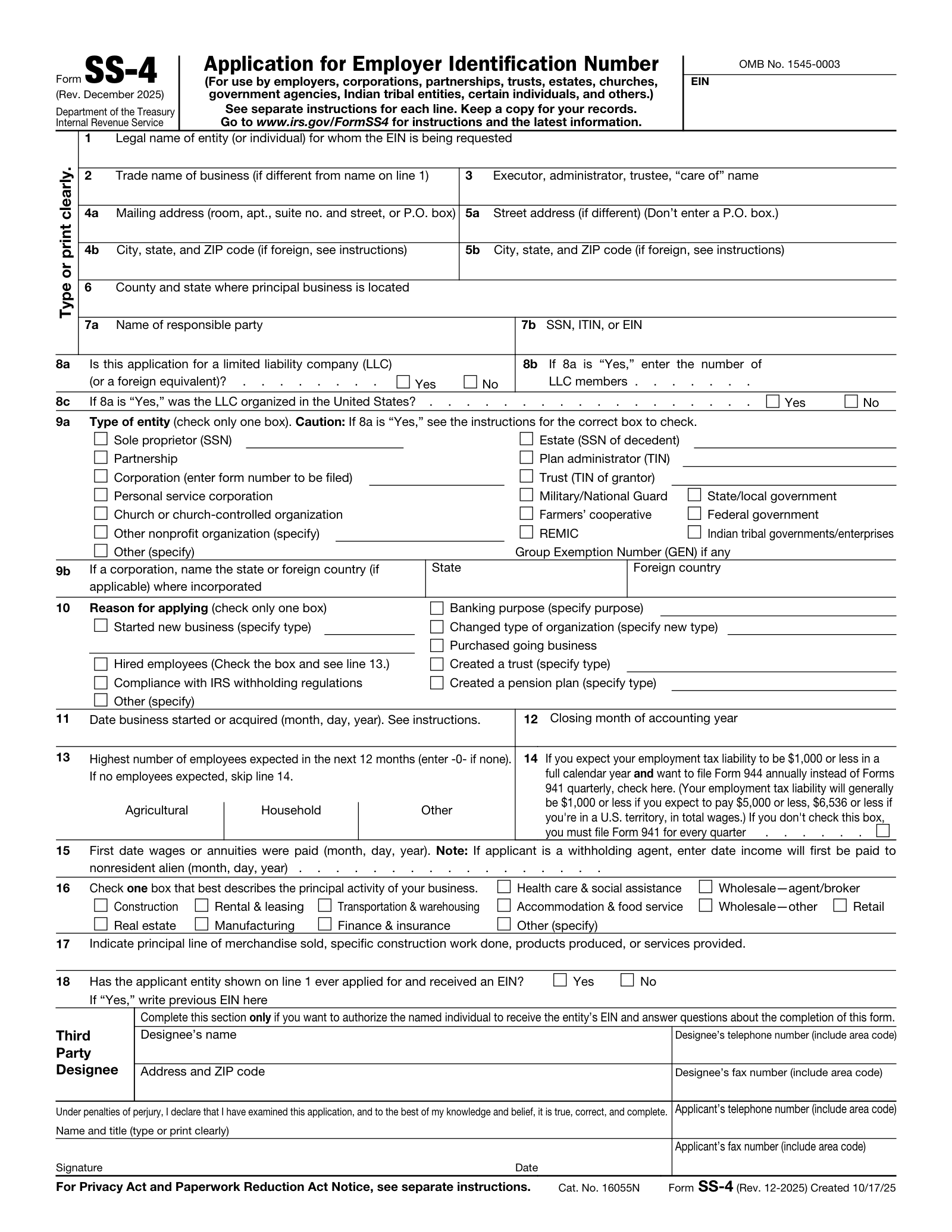
Official form (IRS.gov): Form SS-4 official PDF
Here is the line-by-line for a foreign-owned LLC, which is the case for nearly every reader of this article:
- Line 1, legal name: exactly as it appears on your state filing. "Nexa Trading LLC," not "Nexa." A mismatch with state records is the single most common reason the IRS bounces an application back.
- Line 2, trade name: your brand if it differs. Otherwise leave blank.
- Line 3a, executor/trustee: N/A. This line is for estates.
- Line 4a/4b, principal activity: be plain. "E-commerce," "software consulting," "digital marketing." Do not write "holding company" unless that is genuinely what it is, because it invites questions.
- Line 5a, started new business: check it.
- Line 7a, responsible party: the human being with ultimate control. That is you, the member or manager. Not the registered agent. Not the formation company. You.
- Line 7b, SSN/ITIN/EIN: the pain point. Covered in the next section.
- Line 8a, entity type: check "Limited liability company" and enter the number of members on 8b. A single-member LLC writes 1.
- Line 9, who is applying: check "Other" and write "Foreign-owned U.S. LLC" or "Foreign corporation" as appropriate.
- Line 10, reason for applying: "Started new business" or "Banking purpose." Both are accepted.
- Line 11, date business started: the date your state accepted the formation filing.
- Line 18, third-party designee: leave it blank unless you are authorizing a specific person in the US to speak to the IRS on your behalf.
Say your Wyoming LLC was formed on 3 March 2026 and you write "March 2026" on Line 11. The IRS wants a date, not a month. Write 03/03/2026. Small thing, real delay.
Line 18 deserves a note. Checking "Yes" authorizes a named designee to receive the IRS's calls and correspondence about this application. If your registered agent or a US-based accountant will handle IRS contact, this is useful. If not, leave it blank. A blank Line 18 has never delayed an EIN.
What do you write in the responsible party section when you have no SSN or ITIN?
Write your own legal name on Line 7a, exactly as it appears on your passport. On Line 7b, check the box indicating the number has been applied for, or enter "Foreign" where the IRS instructions allow it for a responsible party living abroad. Never leave 7b blank.
The responsible party is the individual who controls the entity: the sole member of a single-member LLC, a managing member of a multi-member LLC, or an officer of a corporation. The IRS wants a person, not a company. [3]
Three scenarios, three answers:
Single-member LLC, Indian founder. Line 7a: your full legal name. Line 7b: check "applied for" if you have an ITIN application pending, or enter "Foreign" per the instructions. This is the standard path and the IRS accepts it.
Multi-member LLC. One responsible party only. Pick the member with the largest stake or the managing member. Listing two people on 7a creates a mismatch the IRS has to resolve by letter.
C-Corp with a non-resident director. The responsible party is typically the president or principal officer, even if that person lives in Bengaluru. Same rule applies on 7b.
Now the mistake that costs the most time: writing the registered agent's name or the formation company's name on Line 7a. Founders do this because the agent has a US address and it feels cleaner. It is not. The IRS expects the individual owner or officer, and an agent listed as responsible party triggers a request for more information. [4]
Heads-up: the IRS can and does send a letter asking you to clarify the responsible party. Respond within the deadline on the letter with a signed statement naming the correct individual. Ignoring it means no EIN.
If you plan to file US personal returns later, an ITIN is a separate application on Form W-7. See how to apply for an ITIN for that track.
Should you apply online, by fax, or by mail, and how long does each take?
Non-residents cannot use the IRS online EIN assistant. It requires a valid SSN, ITIN or EIN for the responsible party, and a founder in Mumbai has none of those. Fax is the fastest route. Mail works. Phone is for international applicants in specific cases only. [3][5]
| Method | Who can use it | Typical turnaround | Government cost | Notes |
|---|---|---|---|---|
| Online assistant | Responsible party with a valid SSN/ITIN/EIN | Same session | Free | Blocked for most non-residents |
| Fax (Form SS-4) | Anyone | About 4 business days for the IRS fax-back | Free | Keep the fax confirmation page |
| Mail (Form SS-4) | Anyone | Several weeks | Free | Send tracked courier, not ordinary post |
| Phone | International applicants, per IRS instructions | Varies | Free | Confirm eligibility before calling |
Cost is not the differentiator. The IRS charges nothing for an EIN. Every dollar you see quoted for "EIN service" is a third-party agent fee or courier cost, and it is optional. [3]
Fax mechanics, in order: complete the SS-4, sign it, fax it to the IRS number listed in the SS-4 instructions for your state of formation, and keep the confirmation page. The IRS faxes the EIN back, usually within about four business days..
Suppose you fax on a Friday afternoon from India. The IRS receives it Monday morning US time. Your four business days start Monday, not Friday. Budget a week and you will not be disappointed.
Mail works fine if you are not in a hurry. Send it tracked. A lost SS-4 in international post means starting over, and the IRS has no record to check against.
Do not pay an agent to "expedite" an EIN. There is no expedite lane. The IRS processes in the order received.
What happens after the EIN is issued, and what can you do with it?
You receive a CP 575 notice, the IRS letter that states your EIN and the entity name. That letter is your proof of the number. Use the EIN to open a US business bank account, register with payment processors, and file federal returns. It is not a bank account, a credit score, or a substitute for an ITIN.
Lost the CP 575? Request a Letter 147C, the IRS's replacement confirmation. Call the IRS Business & Specialty Tax Line and ask. Banks accept a 147C in place of the original notice..
Now the obligation most founders miss. A foreign-owned single-member LLC generally files Form 5472 with a pro forma Form 1120 each year, and failure to file carries a penalty.. This is an annual filing, not a one-time form. Put it in your calendar the day you get the EIN.
Banking is its own project. Plenty of US banks still ask non-resident owners for an ITIN or an in-person visit. Fintechs are more flexible but make their own approval decisions. An EIN makes you eligible to apply. It does not guarantee approval, and no provider promises that. If you want the online route, see opening a US business bank account.
Imagine you get the EIN on a Tuesday and apply to a payment processor the same week. They ask for a W-8BEN-E and a bank account. The EIN was step one of five. Sequence it: entity, EIN, bank account, payments, tax filings.
Why is your EIN application delayed or rejected, and how do you fix it?
Most delays come from a blank or inconsistent responsible party line, an entity name that does not match state records, a missing signature, or a fax sent to the wrong IRS campus. Each has a direct fix.
| Symptom | Likely cause | Fix |
|---|---|---|
| No fax-back after a week | Wrong campus fax number, or fax not received | Confirm the number in the SS-4 instructions for your state, refax, keep the confirmation |
| IRS letter asking for more information | Responsible party unclear or missing | Reply by the deadline with a signed statement naming the individual |
| Application rejected on name | Line 1 differs from state filing | Refax with the exact legal name |
| Long silence after mailing | Ordinary post delay | Call the IRS Business & Specialty Tax Line with your copy of the SS-4 |
To check status, call the IRS Business & Specialty Tax Line. Have your fax confirmation and a copy of the SS-4 in front of you. International applicants can call this line..
Do not refax the same SS-4 three times in a week. Duplicate submissions create duplicate records and slow everything down. One fax, one confirmation, one week of patience, then call.
Common Mistakes
- Listing the registered agent or formation company as responsible party. The IRS expects the individual owner or officer. This is the top rejection trigger. [4]
- Leaving Line 7b blank. Check "applied for" or enter "Foreign." A blank line reads as an incomplete application.
- Using the online assistant without an SSN or ITIN. The tool requires a valid number for the responsible party. It will not work for you. [3]
- Faxing to the wrong campus. The fax number depends on your state of formation. Pull it from the SS-4 instructions, not from a blog post.
- Assuming the EIN replaces an ITIN. They are different numbers for different purposes. An EIN does not let you file a personal US return.
- Forgetting the annual 5472/1120 filing. This is a recurring obligation with a penalty attached, not a one-time step.
- Applying before the entity exists. The IRS issues the EIN to a registered business. Form the LLC first. [6]
My blunt calls: fax, do not mail, unless you genuinely have six weeks to spare. Enter your own name on Line 7a even though the agent's US address looks tidier. And skip paid EIN "expedite" services, because there is no expedite lane to buy.
If the tax side is where you want help rather than the form, federal tax support for Form 5472 and Form 1120 covers the annual filings. For the EIN itself, EIN assistance for non-US residents walks the SS-4 with you.
Frequently Asked Questions
Can I get an EIN without an SSN or ITIN? Yes. The entity gets the EIN. The responsible party's SSN or ITIN is not strictly required if you check "applied for" or enter "Foreign" per the IRS instructions.
What exactly do I write on Line 7b of Form SS-4? Your SSN, ITIN or EIN if you have one. Otherwise check the "applied for" box or write "Foreign" as the instructions allow. Never leave it blank.
Can non-residents use the IRS online EIN assistant? No, in practice. The tool requires a valid SSN, ITIN or EIN for the responsible party. Non-residents fax or mail Form SS-4.
How long does an EIN take by fax versus mail? Fax is faster, with the IRS faxing back in about four business days. Mail takes several weeks. Confirm current IRS processing times before you plan around them.
Does the IRS charge a fee for an EIN? No. The EIN is free. Any charge comes from a third-party agent or courier.
What filings does a foreign-owned LLC need after getting an EIN? A foreign-owned single-member LLC generally files Form 5472 with a pro forma Form 1120. Other entity types file Form 1120 or 1120-S. Confirm your situation with a qualified tax professional.
NexFyla helps non-US founders form US companies and set up EIN and US business banking support. If you want help with US LLC formation, EIN and business setup, NexFyla can assist.
*Last updated: February 2026.*
Should you apply for an EIN before or after your LLC is formed?
Form the LLC first. Then apply for the EIN. Form SS-4 asks for your entity's formation state and date, and the IRS expects the entity to legally exist when you apply [1].
Quick Answer: For a non-US resident, the sequence is: state approves your LLC, then you file Form SS-4 for an EIN. The EIN is free from the IRS and takes one of three routes without an SSN: fax, mail, or phone for international applicants. Apply too early and the name on your SS-4 will not match the state record, which triggers IRS follow-up and delays bank onboarding.
That sequencing question is where most guides go quiet. They list the application channels, then move to banking. The order matters more than the channel.
Say your Wyoming LLC is approved on 3 March with the legal name "Kestrel Labs LLC." Your SS-4 line 1 must read exactly that, including the suffix. Write "Kestrel Labs" and the IRS may come back to you, and your bank will flag the mismatch when it compares the EIN letter to your Articles of Organization.
What "formation date" actually means
It is the state's effective date, not the day you clicked submit on the formation portal. Wyoming, Delaware and most other states stamp an effective date on the filed Articles of Organization (the document that creates your LLC). Use that date on SS-4 line 8a.
A foreign entity that is not forming a US LLC can still apply for an EIN with a foreign address. The same logic holds: legal existence first, tax ID second.
If you have not formed the entity yet, start with US LLC formation for non-residents and come back to this page once the state has approved the filing.
Which EIN application method can a non-resident actually use?
Fax, mail, or phone. The online application is effectively closed to you unless you already hold a valid SSN, ITIN or EIN, because the portal's identity step requires one [1]. The IRS confirms international applicants may apply by phone, and fax and mail remain open to everyone [4].
Official form (IRS.gov): Form SS-4 official PDF
| Method | Who can use it | Typical turnaround | What you need | Trade-off |
|---|---|---|---|---|
| Online | Applicants with a valid SSN, ITIN or EIN | Immediate | US tax ID for the responsible party | Not available to most non-residents |
| Fax (SS-4) | Anyone | Days to a couple of weeks | Signed SS-4, cover sheet, return fax number | You need a working fax line both ways |
| Mail (SS-4) | Anyone | Several weeks | Original signed SS-4 | Slowest route, and you wait on international post |
| Phone (international applicants) | International applicants | Often same call | Completed SS-4 in front of you | Call timing and international dialing |
| Paid agent handling fax | Anyone | Days to a couple of weeks | Signed SS-4 and authorisation | Provider fee on top of a free government number |
Turnaround figures vary with IRS workload, so treat the middle column as a planning range, not a promise
The phone route, honestly
The IRS states that international applicants may apply by phone [4]. In practice that means you call the IRS number for international callers, hold your completed SS-4 in front of you, and answer questions from the form. If the agent processes it, you get the EIN on the call.
It is the fastest legitimate path. It is also the one where a half-filled form gets you bounced, so have every field ready before you dial.
What fax and mail actually require
Fax needs a cover sheet and a return fax number the IRS can send the reply to. Mail needs the original signed SS-4, posted to the address in the instructions. Neither route accepts a scanned signature by email.
On cost: the EIN is free from the IRS. Every rupee or dollar a service charges is a provider fee, not a government fee. Separate the two when you compare options.
If you want the fax or phone handled for you, getting an EIN as a non-US resident covers the assisted route.
What information do you need before starting Form SS-4?
Six things: the exact legal name, a business address, the formation state and date, the responsible party's details, the entity type, and the reason for applying. Get all six on paper before you open the form.
Checklist:
- Legal name copied character for character from the state approval, including "LLC" or "L.L.C."
- Principal business address, which can be your registered agent's address (the local contact who receives official mail for your company) if the state allows it
- Responsible party name and address, plus "Foreign" on line 7b if you have no SSN or ITIN
- Entity type on line 9: single-member LLC, multi-member LLC, or corporation
- Date business started and closing month of the accounting year
- Reason for applying on line 10
On line 10, most new LLCs check "Started new business" or "Banking purpose." "Compliance with IRS withholding regulations" is not the default and does not apply to a plain operating LLC.
Heads-up: line 7b is the field that sinks the most non-resident applications. The SS-4 instructions tell you to write "Foreign" when the responsible party has no US tax ID. Write an ITIN you do not have, or leave it blank, and the application stalls.
For a field-by-field walkthrough, see federal tax support for Form 5472 and Form 1120.
How do you name a responsible party without an SSN or ITIN?
You name yourself. A non-resident can be the responsible party of a US LLC, and you write "Foreign" on line 7b in place of an SSN or ITIN [1]. You do not need an ITIN to get an EIN.
The responsible party is the person who controls the entity: the managing member of an LLC, the president of a corporation. That is you, the founder.
The nominee shortcut is a bad trade
Some founders list a US friend or a paid nominee to avoid the "Foreign" field. Do not do this. The responsible party must be the person who actually controls the company. A nominee creates a false record with the IRS, confuses your bank's know-your-customer checks, and gives a stranger signature authority over your tax identity.
If you later obtain an SSN or ITIN, the IRS record can be updated. The EIN itself does not change.
ITIN and EIN are different tools
An ITIN (Individual Taxpayer Identification Number, applied for on Form W-7) is for your personal tax filing. An EIN is for the business. Applying for an ITIN first adds weeks to your timeline and does not speed up the EIN at all. If you need both, run them in parallel, not in sequence.
Imagine you are a founder in Bengaluru with no US tax ID. You form a Delaware LLC, write "Foreign" on line 7b, and apply by phone. Nothing about that path requires an ITIN, and nothing about it is unusual to the IRS agent on the line.
What happens after you submit Form SS-4, and how long should you wait?
The IRS assigns the EIN and sends a CP 575 notice, the letter that states your EIN and entity details. If you applied by phone, you get the number on the call and the CP 575 follows by post. If the original letter is lost later, the IRS can issue a 147C letter as a replacement.
| Method | Typical wait | How you receive the EIN | If it does not arrive |
|---|---|---|---|
| Phone | Same call in many cases | Verbal, then CP 575 by post | Call the IRS with your SS-4 details |
| Fax | Days to a couple of weeks | Fax back to your number | Follow up by phone |
| Several weeks | Post to the SS-4 address | Follow up by phone | |
| Online (if eligible) | Immediate | Downloadable letter | Not applicable |
| Agent-handled fax | Days to a couple of weeks | Agent forwards the letter | Agent follows up |
Exact 2026 processing times need checking against current IRS guidance before you plan around them
While you wait, do not open the bank account or file returns. You can draft your operating agreement (the internal document that sets out ownership and management), prepare your bank application, and gather your formation documents.
How do you use the EIN for banking, payments, and tax filings?
The EIN is your company's tax ID. It goes on the business bank account application, the payment processor profile, and every annual return. Your personal SSN or ITIN stays separate and personal.
Banks and processors ask for the EIN plus your formation documents and ownership ID. A US LLC with a non-resident owner may make you eligible to apply, but approval stays the provider's decision. Nobody can promise it.
Payers will also ask for a tax form. A non-resident-owned entity typically provides Form W-8BEN-E (the withholding certificate for foreign entities) rather than Form W-9, which is for US persons.
The annual filing you cannot skip
A foreign-owned single-member LLC that is disregarded for US tax purposes generally files a pro forma Form 1120 with Form 5472 attached each year. The EIN is required on both. Missing this filing carries a penalty, so put it in the calendar the day the EIN arrives
The EIN does not replace an ITIN for your personal return, and it does not by itself make you a US tax resident. Ownership, US-source income, treaty position and state nexus all feed into your tax position. Get a qualified tax professional to look at your facts.
Suppose you sign up for a payment processor two weeks after the EIN lands. The onboarding form asks for the EIN, the legal name, and the country of the owner. If the name matches your CP 575 and your state filing, onboarding moves. If it does not, you are back in the queue.
How do you fix an error or get a replacement EIN letter?
The fix is a phone call to the IRS business line. Name and address corrections, and 147C replacement letters, are handled there rather than through a new application. The EIN number itself rarely changes.
Have your EIN, legal name, address and responsible party details ready. The IRS can fax or mail the 147C letter
Common fixes:
- Misspelled entity name on the IRS record
- Wrong formation date on SS-4 line 8a
- Wrong responsible party listed
- Lost CP 575, needing a 147C
If the EIN was issued to an entity that should never have existed, that is a new application, not a correction. Ask the IRS which situation you are in before you file anything.
How do you keep EIN records consistent across state and federal filings?
Use one exact legal name and one EIN on every document. State annual report, bank forms, tax returns, payment processor profiles, the FinCEN beneficial ownership filing if it applies to you. Mismatches are what slow everything down.
The name-change case is the one people forget. If your LLC changes its name, or moves state, update the IRS record, then the bank, then the processor. Keep the CP 575 or 147C with your company records permanently, because you will be asked for it again.
What to do next
Form the LLC. Wait for the state approval. Fill every SS-4 field, write "Foreign" on line 7b, and call the IRS international line with the form in front of you. That is the whole sequence, and it costs nothing but a phone call.
If you want help with US LLC formation, EIN and business setup, NexFyla can assist. We help non-US founders form US companies and set up EIN and US business banking support. You can also see NexFyla pricing and package costs before you decide.
*Last updated: February 2026.*
Related reading
- How to Get an EIN for a Non-US Resident in 2026 Without an SSN
- EIN for a Non-Resident LLC in 2026: Do You Need an ITIN First?
- IRS ITIN Application Requirements in 2026: What Non-Residents Must Submit
Ready to act on this? EIN assistance takes the filing, registered agent and paperwork off your desk.
About the author
Ashwini Dhangar is a Senior Corporate Structuring Specialist and US company formation advisor at NexFyla. She works with non-resident founders on LLC formation, EIN and ITIN filings, and US business banking — and has handled these filings for founders across India, the UK and the Gulf. More about the team · LinkedIn