Table of Contents
▼
Who actually needs an EIN, and why does your LLC need one separately from you?
Every US LLC and corporation needs its own EIN (Employer Identification Number), even with no US employees [4]. That number is the business entity's federal tax ID. It is not your personal tax ID. Your SSN or ITIN, if you have one, identifies you as an individual. The EIN identifies the company.
Quick Answer: The IRS issues an EIN free. A non-resident can get one without an SSN or ITIN. You file Form SS-4 by fax, mail, or phone. The online assistant is closed to you. Your LLC needs its own EIN because banks ask for it, vendors ask for it, and the IRS wants it on your annual return.
You need an EIN when you open a US business bank account. You need it when a US customer sends you a Form W-9 and you have to explain why you file a W-8BEN-E instead. You need it when you hire. You need it for excise tax. And you need it for the one filing that catches almost every foreign-owned single-member LLC: Form 5472 with a pro forma Form 1120.
That last point trips people up. A single-member LLC owned by a non-resident is disregarded for federal income tax. The IRS pretends the LLC does not exist for income tax purposes. You might assume that means no EIN, no return, no paperwork. Wrong. A foreign-owned disregarded entity files Form 5472 each year, attached to a pro forma Form 1120, and the EIN is the number on that return. Skip it and the penalties are real. If you want the mechanics of that filing, see our guide to federal tax support for Form 5472 and Form 1120.
So the EIN is not optional admin. It is the anchor for everything after formation.
Reading Form SS-4 as a non-resident: which lines matter most?
Non-residents fill the same Form SS-4 as everyone else. The difference is precision on five lines: 7b, 8a/8b, 9, 10, and 11. Those are where the form asks for US tax IDs and dates that a foreign founder does not have in the usual form.
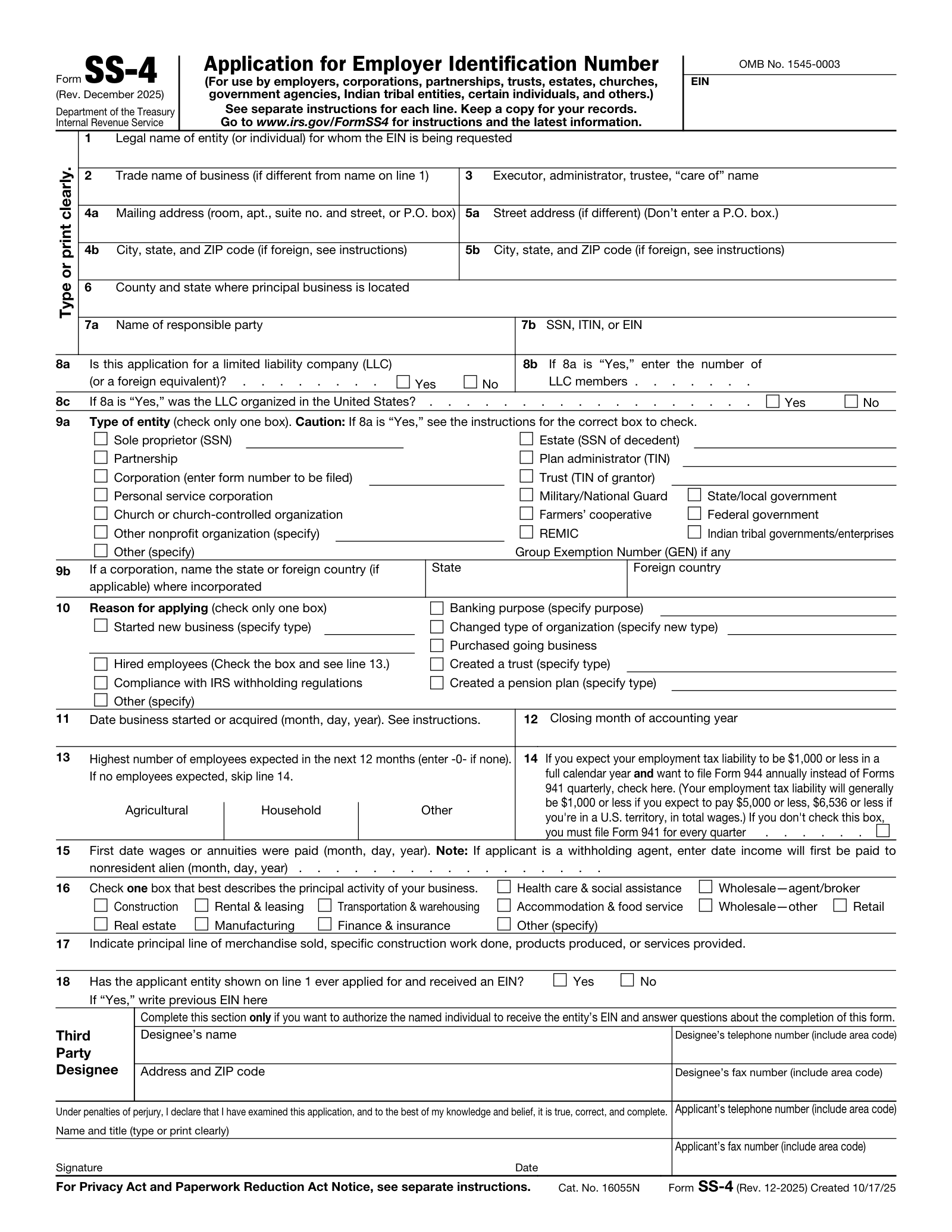
Official form (IRS.gov): Form SS-4 official PDF
Here is the line map that matters. Read it with the official instructions open beside you [4].
| Line | What it asks | What a non-resident enters |
|---|---|---|
| 1 | Legal name of entity | Exactly as on your state formation document |
| 2 | Trade name | Your brand name, if different |
| 3 | Executor, administrator, trustee | Leave blank for an LLC |
| 4 | Mailing address | Where you want IRS mail sent, including a foreign address |
| 5a/5b | Street address, city/state/ZIP | Your LLC's registered address in the US |
| 6 | County and state where principal business is located | The US county of that address |
| 7a | Responsible party name | Your full legal name |
| 7b | SSN/ITIN/EIN of responsible party | Follow the SS-4 instructions for a foreign responsible party with no US tax ID |
| 8a | Entity type | Check "Limited liability company" and enter member count |
| 8b | Number of members | 1 for a single-member LLC |
| 8c | Was the LLC organized in the US? | Yes |
| 9 | Date business started | Your state formation date |
| 10 | Reason for applying | Check "Started new business" |
| 11 | Date wages paid | N/A if no employees |
| 12 | Closing month of accounting year | December |
| 13 | Number of employees | 0 if none |
| 14 | Principal activity | Your actual business, e.g. software, consulting |
| 15 | Check if applies | Usually none |
| 16 | Prior EIN? | No, unless replacing one |
| 17 | Signature | You sign as the responsible party |
| 18 | Third-party designee | Fill only if an agent files for you |
Line 7b is the one that stops people. The form wants a US tax ID for the responsible party. A non-resident often has none. The SS-4 instructions tell you what to write in that case; check the current wording before you send the form, because the exact entry has shifted over the years Do not leave it blank and hope. Do not invent a number.
One more line worth slowing down on: line 8a. A single-member LLC is still an LLC. Check the LLC box, write "1" for members, and answer 8c "Yes" because the entity was organized in the US even though you were not.
What do you enter for the responsible party when you have no SSN or ITIN?
You enter your own legal name and foreign address. A non-resident individual can be the responsible party without an SSN or ITIN. The IRS does not require the responsible party to hold a US tax ID to obtain an EIN.
The responsible party is the individual who controls, manages, or directs the entity and its funds and assets. For a founder-owned LLC, that is you. Not your registered agent. Not your formation company. You.
Say your LLC is registered in Wyoming, you live in Pune, and you have never set foot in the US. You are still the responsible party. Your name goes on line 7a, your Indian address goes in the responsible party section, and line 7b gets the entry the instructions call for. The EIN comes back in your name, tied to your LLC.
Now the part people confuse. Some US banks and payment processors prefer a US-based signer or responsible party. That is a commercial preference, not an IRS rule. The IRS will issue the EIN to a foreign responsible party. Whether a specific bank opens the account is a separate decision that belongs to that bank. An LLC may make you eligible to apply; approval stays with the provider.
An ITIN is not required for an EIN. They are different numbers for different purposes. If you later need an ITIN, for example to file a personal US return, that is a separate Form W-7 process, and you can read about applying for an ITIN with Form W-7 when you get there.
Fax, mail, or phone: which SS-4 route should a non-resident choose?
Non-residents cannot use the IRS online EIN assistant. The practical routes are fax, mail, and phone. The IRS says international applicants may apply by phone [3][4]. The online assistant is built for applicants with a US tax ID and a US address, which is why it rejects most foreign founders [5].
| Route | Who can use it | Typical turnaround | How you receive the EIN | Notes |
|---|---|---|---|---|
| Online | Applicants with a US SSN/ITIN/EIN and US address | Minutes | On screen | Closed to most non-residents |
| Fax | Anyone filing Form SS-4 | Days to a few weeks | Fax back to your number | Fastest paper route if you include a return fax number |
| Anyone filing Form SS-4 | Weeks | By post | Slowest; use tracked mail | |
| Phone | International applicants | Same call or callback | Read to you, then by post | Time zones matter |
Processing times move. Check the IRS "Get an EIN" page for current estimates before you plan around a number [1].
For fax, use a number you can actually receive on. An e-fax service works. Write the return fax number clearly on the cover sheet and on the SS-4 itself. Keep the transmission confirmation. If the IRS cannot fax back, your application sits.
Imagine you fax on a Monday from Bengaluru and hear nothing for ten days. That is normal, not a rejection. The IRS does not email status updates. Your confirmation page is your only proof until the EIN letter arrives.
For phone, have the completed SS-4 in front of you and know your formation date and legal name exactly. The international line runs on US hours, so a founder in India is usually calling late at night. That is the tradeoff for same-day answers.
For mail, send tracked. Include every attachment. A lost envelope costs you a month.
My call: fax first. It is the fastest route that leaves you a paper trail. Use phone only if you can sit up for the US time window. Skip mail unless fax is impossible.
What should you attach to your SS-4 to avoid delays?
Attach a copy of your LLC formation document, your Articles of Organization or Certificate of Formation, and any document the IRS asks for. The legal name on that document must match line 1 of your SS-4 character for character.
Suppose your Wyoming Articles of Organization say "Northstar Analytics LLC" and your SS-4 says "Northstar Analytics L.L.C." That difference is enough to trigger a mismatch. Fix the name on the form, not on the state filing. If the state document itself is wrong, amend it first.
If a formation agent or accountant files for you, they complete the Third Party Designee section, line 18, and you sign the form. That section lets the IRS talk to your agent about the application [3].
What not to send: passport copies, SSN cards, personal tax returns. The IRS did not ask. Extra paper slows the file.
Heads-up: whether the IRS wants a certified or apostilled copy of a foreign-language formation document varies by case. If your document is not in English, include a certified translation
After the EIN is issued: what should a foreign founder do first?
Save the IRS notice. That is the CP 575 letter, or the faxed EIN confirmation. Check the legal name and address on it against your state filing. If something is wrong, fix it now, not after your first tax return.
If you lose the letter, or it never arrives, call the IRS Business & Specialty Tax Line and request a 147C letter. That is the IRS's replacement document confirming your EIN. It comes by fax or mail. You need it when a bank or vendor will not accept a printout.
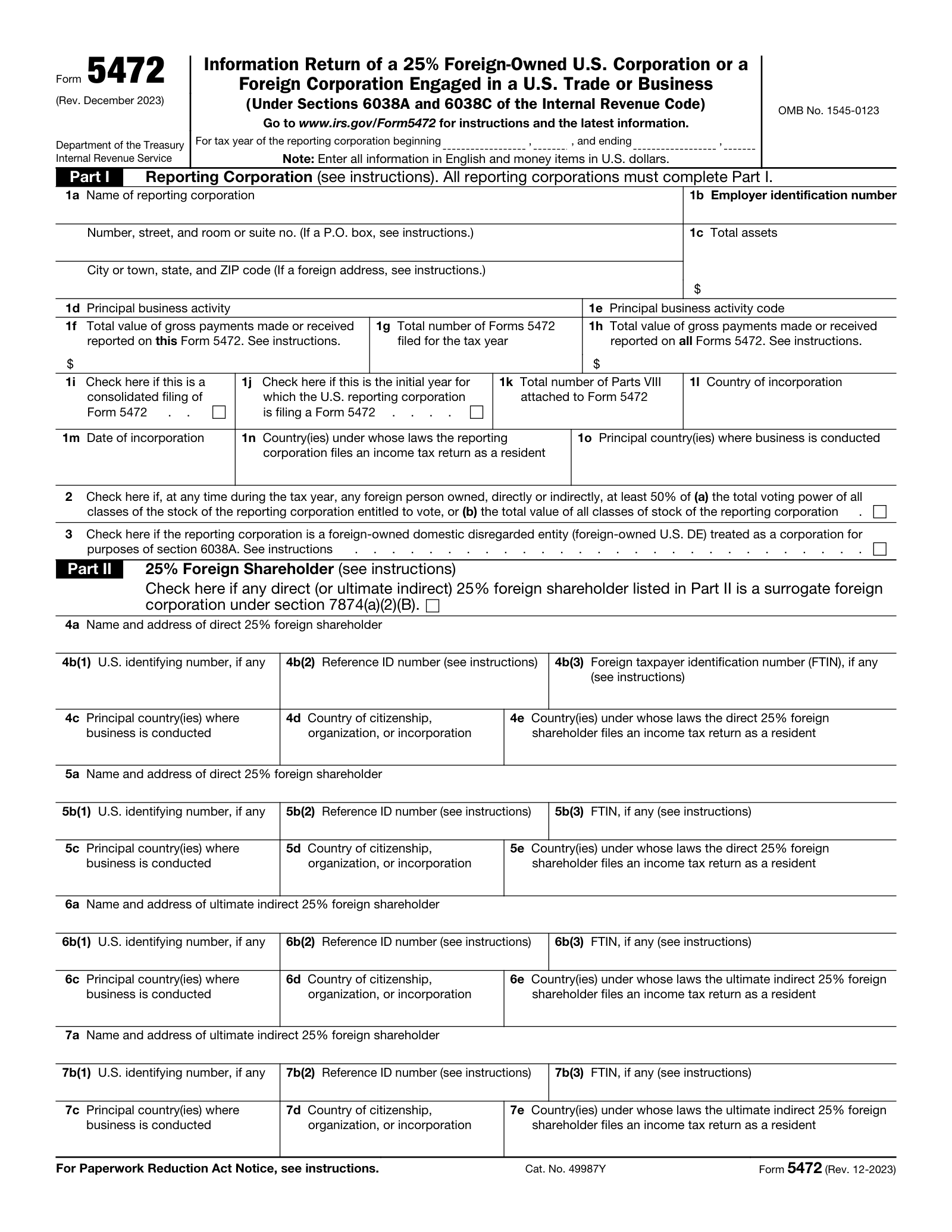
Official form (IRS.gov): Form 5472 official PDF
Then the annual obligations start. A foreign-owned single-member LLC files Form 5472 with a pro forma Form 1120. A multi-member LLC files Form 1065. A corporation files Form 1120. Get the entity classification right early, because it decides which return you file every year.
On vendor forms: a foreign entity generally provides Form W-8BEN-E, not Form W-9. W-9 is for US persons. Handing a W-9 to a US customer when you are a foreign entity creates confusion you then have to unwind.
On FinCEN BOI reporting: the rules changed in 2025 and the treatment of foreign-owned entities has been in flux. Check the current FinCEN guidance for your entity type before you file or skip anything
Common Mistakes
Most SS-4 rejections come from four things: a name mismatch, a missing attachment, a bad responsible party entry, or using the online assistant when you are not eligible.
- Name mismatch. Line 1 must match the state document exactly. Punctuation, "LLC" versus "L.L.C.", and missing periods all count.
- Blank line 7b. Follow the instructions for a responsible party with no US tax ID. A blank field gets the form kicked back.
- PO box as physical address. Line 5a wants a street address. Use your registered agent's US street address if you have no US premises.
- Wrong entity type on line 8a. A single-member LLC is an LLC with one member, not a sole proprietorship.
- Unsigned line 17. No signature, no EIN.
- Fax with no return number. The IRS has nowhere to send the EIN.
- Wrong IRS fax number. International and domestic applications go to different numbers. Check the current SS-4 instructions [4].
- Paying for the EIN itself. The IRS charges nothing. Any fee is a convenience charge from a provider.
Fix and resubmit. There is no penalty for a corrected application, only lost time.
How much does an EIN cost, and which costs are government vs provider vs recurring?
The IRS charges $0 for an EIN [2]. Every dollar you pay to get one is a provider fee for someone else doing the paperwork.
| Item | Government fee | Provider fee | Recurring? |
|---|---|---|---|
| EIN from the IRS | $0 | Optional | No |
| State LLC formation | Check the current official fee | Optional | No |
| Registered agent | $0 | Yes | Yes, annually |
| 147C replacement letter | $0 | Optional | No |
| Form 5472/1120 prep | $0 | Yes | Yes, annually |
| State annual report or franchise fee | Check the current official fee | Optional | Yes |
Using a formation company for the EIN is optional. Plenty of founders fax the SS-4 themselves and keep the money. If you want the formation and EIN handled together, look at NexFyla pricing before you decide.
Frequently Asked Questions
Can I get an EIN without an SSN or ITIN? Yes. The IRS does not require the responsible party to hold a US tax ID. Follow the SS-4 instructions for line 7b.
Can non-residents apply for an EIN online? No. The online assistant is built for applicants with a US tax ID and US address. Use fax, mail, or phone.
How long does an EIN take by fax for a non-resident? Days to a few weeks if you include a return fax number. Check the IRS page for current times [1].
What documents should I attach to Form SS-4? A copy of your LLC formation document. The legal name must match line 1 exactly.
What is a 147C letter and when do I need one? An IRS letter confirming your EIN. Request it by phone if you lost the original notice.
Does a foreign-owned LLC need to file Form 5472 after getting an EIN? Yes. A foreign-owned single-member LLC files Form 5472 with a pro forma Form 1120. Penalties apply for non-filing.
*Last updated: March 2026.*
Can a non-resident get an EIN without ever setting foot in the US?
Yes. The IRS issues EINs to foreign-owned entities that have no US office, no US employees and no US tax ID for the owner. The only channel closed to you is the online application, which requires an SSN or ITIN. Form SS-4 by fax, mail or international phone is the route that works.
Quick Answer: A non-resident can get an EIN for a US LLC or corporation by filing Form SS-4 by fax, mail or the IRS international phone line. No SSN or ITIN is required. You leave the SSN/ITIN boxes blank and enter a foreign passport or national ID number on Line 7b. The EIN belongs to the entity, not to you personally.
An EIN is the federal tax ID number for a business, tax-exempt organisation or other entity [2]. It is nine digits, it is free, and it is issued by the IRS, not by a state. Your Wyoming or Delaware filing created the company. The EIN is what lets that company be taxed, banked and paid.
Four numbers get mixed up constantly. Keep them apart:
- SSN - a Social Security number, issued to US citizens and authorised workers. You do not have one and you are not applying for one.
- ITIN - an Individual Taxpayer Identification Number, issued by the IRS to people who need to file a US individual return but cannot get an SSN. It is personal, not corporate.
- TIN - the umbrella term. An SSN, an ITIN and an EIN are all TINs. When a bank form asks for a TIN, an EIN satisfies it.
- EIN - the entity's number. This is the one you are here for.
One correction before you go further: the EIN does not replace your state formation documents, and it does not register you for state tax. Wyoming does not know or care that you have an EIN. If your state requires a separate sales tax or withholding account, that is a second registration with a second agency.
Say your LLC was formed in Wyoming in March and you live in Pune. You file SS-4, get the EIN in April, and open a Mercury account in May. None of those steps touch the Wyoming Secretary of State. Your annual report there is a separate obligation with a separate deadline.
Who actually applies - the entity or the owner?
The entity applies. A foreign-owned LLC, a C-corp and a partnership each get their own EIN, and that number is separate from every owner's personal tax identity. You sign the form as the responsible party, but the applicant is the company.
The one exception: a sole proprietor with no entity at all applies as an individual. If you formed an LLC, that is not you.
Order matters here. The SS-4 asks for the entity's legal name, the state where it was formed, and the date it started. You cannot answer those before the Articles of Organization are filed and accepted. Form the company first, then apply for the EIN. Founders who reverse it end up faxing an amended SS-4.
A foreign company can also need an EIN. If an Indian private limited company opens a US branch, holds US real estate, or has US-source income subject to withholding, it files the same SS-4. The form does not change. The answers do.
If the company does not exist yet, start with US LLC formation for non-residents and come back to this page once the state has issued your filed-stamped documents.
Filling out Form SS-4 when you have no SSN or ITIN
Leave the SSN and ITIN boxes empty and put your foreign ID on Line 7b. The SS-4 instructions allow a passport number or national ID number for a responsible party who has no US tax ID. That single line is what makes the form workable for a non-resident.
Official form (IRS.gov): Form SS-4 official PDF
Here is what goes where, in the order you will type it.
Line 1 - legal name. Exactly as it appears on the Articles of Organization, including the suffix (LLC, Inc., Corp.). If the state recorded "Nimbus Labs LLC" and you type "Nimbus Labs", the IRS may bounce it back.
Line 2 - trade name. Your brand name, if it differs. Otherwise blank.
Line 3 - executor, administrator, trustee. N/A for almost every founder reading this.
Line 4a/4b - mailing address. This is where the IRS sends the EIN confirmation. A foreign address is acceptable. Read the delivery section below before you commit to your Indian address.
Line 5a/5b - street address. The entity's physical US location. If your registered agent provides a business address, use it. If you have no US address at all, the IRS instructions allow you to enter your foreign address here too.
Line 6 - county and state. The county where the company was formed, and the state of formation. For a Wyoming LLC registered in Cheyenne, that is Laramie County, WY.
Line 7a/7b - responsible party. Your full legal name on 7a, your passport number on 7b. Detailed below.
Line 8 - entity type. The checkboxes. Most non-resident founders tick LLC and enter the number of members. A corporation ticks Corporation and then the tax-form sub-box (1120 for a standard C-corp).
Line 9 - other entity type. Only if you ticked "Other" on Line 8. Write the description. Do not use this to explain your business.
Line 10 - reason for applying. Started new business, banking purpose, or compliance with IRS withholding. More on this below.
Line 11 - date business started. The date the state accepted your formation filing, not the date you had the idea.
Line 12 - closing month of accounting year. December for nearly everyone. Change it only if you have a real fiscal year and a reason.
Line 13 - employees. Zero is a valid and common answer. Do not inflate it.
Line 14 - agricultural employees. N/A.
Line 15 - prior EIN. Blank unless you are re-applying after losing one.
Line 16 - prior return. Blank for a new entity.
Line 17 - description of business. Short and concrete: "software development", "e-commerce retail", "consulting". Not a paragraph.
Line 18 - third-party designee. This is the line that solves the delivery problem. Covered below.
The trap that catches most people is Line 7a. It is not the company name. It is a natural person's name, and it must be a human being, not another company. If your LLC is owned by a Singapore holding company, you still name the individual behind that holding company.
The responsible party line and what to enter
The responsible party is the natural person who ultimately owns or controls the entity. For a single-member foreign-owned LLC, that is you. Full legal name on 7a, passport number on 7b, and you do not need an ITIN to be named there.
The IRS wants a human it can contact about the account. That person is not always the person who signs the form, and that distinction matters if your CPA files on your behalf.
Three edge cases come up often:
- Two or more owners. Pick the person with actual control. If ownership is 50/50, pick the managing member and be consistent with what your operating agreement says.
- Owned by another company. Name the individual who controls the parent. The IRS will not accept a corporate name on 7a.
- Held in a trust. The trustee or the grantor, depending on who controls the entity. This is the one case where I would get a tax professional to confirm before filing.
Suppose you and a co-founder each own 50% of a Delaware LLC and both live in Bengaluru. You name yourself on 7a, put your passport number on 7b, and your co-founder's name appears nowhere on the form. That is correct. The operating agreement is where the 50/50 split lives.
Which entity type and reason-for-applying box fits your structure?
Tick the box that matches your legal form, then make sure the tax return the IRS expects is the one you actually intend to file. Line 8 is not cosmetic. It sets the IRS's expectation for your first filing season.
| Entity | Line 8 box | Default federal return | Form 5472? |
|---|---|---|---|
| Single-member LLC, foreign owner | LLC, 1 member | Pro forma Form 1120 with Form 5472 attached | Yes |
| Multi-member LLC, all foreign owners | LLC, 2+ members | Form 1065 partnership return | Yes, if a foreign owner has reportable transactions |
| C-corporation, foreign-owned | Corporation (1120) | Form 1120 | Yes, on reportable transactions with foreign related parties |
| Foreign company with a US branch | Other | Depends on the branch's activity | Check with a tax professional |
That first row is the one almost nobody explains at formation. A single-member LLC owned by a non-resident is disregarded for US federal tax purposes by default. It still has to file an annual return: a pro forma Form 1120 with Form 5472 attached, reporting transactions between the LLC and its foreign owner. Skip it and the penalty is steep.
Line 10, the reason for applying, changes what the IRS expects next. Started new business is the honest answer for a freshly formed company. Banking purpose is for an entity that exists for another reason and needs the EIN only to open an account. Compliance with IRS withholding is for entities that will withhold on payments to foreign persons. Pick the true one. If you tick banking purpose and then file a corporate return, you have created a question you did not need.
Form 8832, the entity classification election, is a different form for a different purpose. A default single-member LLC does not need it. File it only if you are electing corporate treatment on purpose, and get advice first. For the downstream filing, see federal tax support for Form 5472 and Form 1120.
Fax, mail, or international phone - which submission route works?
Fax is the practical choice for most non-residents. Mail works but is slow. The international phone line can issue an EIN on the call if the agent can verify you, and it is the only same-day route.
The online application is out. It requires an SSN or ITIN and a US address, and the IRS does not accept email submissions from applicants without one [4].
| Channel | Open to non-residents | Typical turnaround | How you receive the EIN |
|---|---|---|---|
| Online | No | N/A | N/A |
| Fax | Yes | Days to a few weeks | Fax back, or mail to Line 4a |
| Yes | Weeks | Mail to Line 4a | |
| International phone | Yes | Same call, if verification succeeds | Read to you on the call, then mailed |
Heads-up: the IRS fax number for international applicants and the phone line hours change. Confirm both on the IRS "Get an EIN" page before you send anything, and never use a fax number copied from a blog post
Line 18 is the part that makes fax genuinely useful. Name a third-party designee, such as your CPA or the agent who formed the company, and the IRS can fax the EIN to that person instead of mailing it to your address overseas. The designee must sign Line 18. Without a signature the designation is void, and the EIN goes back to the mail queue.
Imagine you are in Hyderabad, the IRS faxes your EIN to your accountant in Texas, and she forwards a scan to you within the hour. You have a working EIN the same week. That is Line 18 doing its job.
What happens when the IRS asks for more information
The IRS may fax or mail a request for clarification before issuing the EIN. Answer it on the same channel, quote the reference number on the notice, and keep a copy of everything you send. If you do not respond, the application is closed and you start again from a blank SS-4.
The usual triggers are boring and fixable:
- Line 7a has a company name instead of a person's name.
- The legal name on Line 1 does not match the state filing character for character.
- Line 10 is inconsistent with the entity type on Line 8.
- Line 7b is blank because you assumed the IRS would look you up.
A closed application creates no tax liability. It does create a delay, and if your bank onboarding or your first Stripe payout depends on the EIN, the delay is the real cost. Fix the specific line the notice names, refax, and note the date you sent it.
How the EIN reaches an overseas address - and how to use it
The IRS mails the EIN confirmation to the address on Line 4a. If that address is in India, delivery takes weeks and sometimes does not arrive at all. Use a US mailing address on 4a or name a third-party designee on Line 18.
The confirmation letter is CP 575, the original notice. If you lose it, the IRS issues a 147C replacement letter on request. Banks accept either, but a printed CP 575 with the IRS letterhead is the one they ask for first.
| Delivery method | Speed | What the bank accepts |
|---|---|---|
| Fax back to third-party designee | Fastest | CP 575 fax or scan |
| Mail to a US address | Days to weeks | CP 575 original |
| Mail to an overseas address | Weeks | CP 575 original, if it arrives |
| 147C replacement | Varies | 147C letter |
Once you have the number, the EIN goes on your bank application, your Stripe or Wise Business onboarding, and your state and federal filings. Payment platforms ask foreign-owned entities for Form W-8BEN-E, not Form W-9. A W-9 is for US persons. Getting that wrong stalls onboarding for weeks.
If you want the account side handled in parallel, see opening a US business bank account as a non-resident. An EIN makes you eligible to apply. Approval stays with the bank, and no one can promise it.
What is an EIN, and which foreign-owned entities actually need one?
An EIN is the IRS's free federal tax ID number for a business. A foreign-owned US entity needs one to file its federal returns, open a US business bank account, and give US payers the number they ask for on a W-9.
Quick Answer: An EIN (Employer Identification Number) is a nine-digit tax ID the IRS issues to businesses for free. A non-US resident who owns a US LLC or corporation needs an EIN to file federal tax returns, open a US bank account, and get paid by US customers. You apply on Form SS-4, and the IRS expects your entity to exist before you apply.
Sequence matters. The IRS tells applicants to form the legal entity first, then apply for the EIN [5]. That order is not bureaucratic fussiness. The name on your SS-4 has to match the name on your Articles of Organization (the state filing that creates your LLC) or your certificate of incorporation. Get the order wrong and the application bounces.
Which structures need one:
- A US LLC with one or more members, including a single foreign owner.
- A US corporation, whether C-Corp or S-Corp.
- A partnership with US filing obligations.
- A foreign entity that has a US trade or business or US withholding obligations.
Three things the EIN is not. It is not a visa or work authorization. It is not a bank account. And it is not an ITIN, which is the individual taxpayer ID a person applies for on Form W-7. Keep those separate in your head, because the IRS keeps them separate in its systems.
If the entity does not exist yet, stop here and sort that first. Our guide to US LLC formation for non-residents covers the state filing step.
Which Form SS-4 fields do foreign applicants most often get wrong?
The recurring failures are the legal name, the entity-type and LLC count lines, the reason-for-applying code, and the responsible party block. Four fields, most of the returns.
Form SS-4 is the IRS application for an EIN. It is two pages, and it is not hard. It is just unforgiving about exactness.
Official form (IRS.gov): Form SS-4 official PDF
Walk the lines in order and the form makes sense.
Line 1, legal name. Copy it character for character from the state formation document. If the state approved "Nexfyla Technologies LLC," you do not write "Nexfyla Tech." A mismatch here is one of the most common reasons an SS-4 comes back.
Line 2, trade name. Only fill this if you actually operate under a different name. If you trade as "Nexfyla," put that here. Do not swap the two lines.
Lines 3 and 4, mailing address and country. Use an address where you actually receive mail. It does not have to be in the US. Put your country code in line 4 if you are outside the US.
Line 7, entity type. Check one box only. A US LLC is "Limited liability company." A corporation is "Corporation." Do not check two.
Lines 8 and 9, the LLC block. Line 8 asks how many members the LLC has. Line 9 asks whether the LLC is filing as a corporation, which connects to Form 8832 (the entity classification election). Answer these honestly, because they change what the IRS expects you to file later. A single-member LLC owned by a foreign person has its own return obligations, covered below.
Line 10, reason for applying. This is where applicants guess. The codes are specific: starting a new business, banking, compliance with IRS withholding, and so on. Pick the code that matches your actual reason. If you need the number to open a bank account, say so. Do not default to "started new business" because it sounds neutral.
Say your state formation document lists "Aurora Labs LLC" but you typed "Aurora Lab LLC" on line 1. The IRS matches names against the formation record, and a one-letter gap can trigger a return. You fix it by refiling with the exact name, and you lose the weeks you spent waiting.
Who can be the responsible party when no one has an SSN or ITIN?
The responsible party must be a natural person who controls the entity. An SSN or ITIN is requested on the form, but the SS-4 instructions allow an entry where the person has none, so a non-resident owner with no US tax ID can still be the responsible party.
Who qualifies: an owner, a managing member, a principal officer. Not a company. Not a nominee registered agent service acting as a stand-in. The IRS wants a human who actually controls the entity.
This trips people up because the responsible party's name is what banks and payers see on EIN lookups. If your LLC's responsible party is you, your personal name sits in the IRS record. That is normal, and it is not a privacy problem you can solve by naming someone else.
The ITIN track is separate. If you want an individual taxpayer ID for yourself, that is Form W-7, not the SS-4. Do not conflate them. Filing a W-7 does not get your LLC an EIN, and getting an EIN does not get you an ITIN. If you need the individual number, our page on applying for an ITIN walks that process.
Note: the current SS-4 instructions spell out exactly what to enter when the responsible party has no SSN or ITIN. Read the instruction page for the revision you are filing, not a blog summary from three years ago.
Fax, phone, or mail: which EIN application route fits a non-resident?
The online EIN assistant requires an SSN or ITIN and a US address, so non-residents use fax, the international phone line, or mail. Fax is the fastest of the three when you supply a return fax number.
Official form (IRS.gov): Form SS-4 official PDF
| Route | Who it suits | What you supply | Timing |
|---|---|---|---|
| Online assistant | Applicants with an SSN/ITIN and US address | Online form | Immediate per the IRS [1] |
| Fax | Most non-residents | Completed SS-4 plus a return fax number | IRS states it faxes the EIN back within about four business days |
| Phone (international) | Applicants who can call the US | SS-4 details read aloud | EIN issued by fax or mail after the call |
| Anyone, slowest | Completed SS-4 to the IRS campus address in the instructions | Weeks, not days |
The IRS describes the online route as free and immediate [1][7]. That is true for the people who can use it. Non-residents generally cannot, because the assistant wants a US address and a US tax ID for the responsible party.
Fax mechanics. Fill the SS-4, sign it, and fax it to the number in the current instructions. Include a cover sheet with your return fax number clearly written. The IRS states it will fax the EIN back within about four business days when you provide that number. If your fax is illegible, you get nothing back, and you will not know why.
Phone route. International applicants can call the IRS and complete the SS-4 verbally. Have the form filled out in front of you before you dial. Reading answers cold off a screen while an agent waits is how fields get mistyped.
Mail route. Slowest, but it works when your fax situation is unreliable. Use the campus address printed in the current SS-4 instructions, not an address from an old forum post.
Heads-up: no provider can guarantee how fast the IRS processes your application. Anyone promising a fixed turnaround is quoting their own workflow, not the IRS's.
Why do EIN applications get returned, and how do you avoid it?
Returns come from incomplete fields, name mismatches, an unsigned form, or an unreachable fax number. They do not come from the applicant being foreign.
Fix these before you send:
- Name mismatch. Compare line 1 against the state formation document, letter by letter.
- Missing reason code. Line 10 left blank or filled with a code that does not match reality.
- Unsigned form. The SS-4 needs a signature from the responsible party. A typed name is not a signature.
- Bad fax number. If the return fax number is wrong or missing, the IRS has nowhere to send the EIN.
- Two entity types checked. Line 7 takes one box.
Part II, the third-party designee box. This is the field almost nobody explains. Naming a designee, with a signed authorization and a five-digit number you choose, lets that person discuss the application with the IRS on your behalf. If your accountant or agent is handling the filing, fill this in. Without it, the IRS will not talk to them about your application, and a stuck file stays stuck.
Suppose your fax went out three weeks ago and nothing came back. First, check the fax confirmation for a completed transmission. Then call the IRS international line with a copy of the SS-4 in front of you and ask for status. If the form was returned, they will tell you which field failed.
What changes once the EIN is issued?
Store the CP 575 notice, give the EIN to your bank and payers, and calendar the federal filings that now apply. The EIN is the start of your compliance calendar, not the end of it.
The CP 575 is the IRS notice that states your EIN. Keep the PDF or paper copy. Banks ask for it during onboarding, and it is the cleanest proof you have.
The filing stack for a foreign-owned single-member LLC. You file Form 5472 together with a pro forma Form 1120. This is an information return, and the penalties for missing it are real. Confirm the current penalty figure on the IRS site before you rely on any number you read elsewhere.
Corporations file Form 1120, or Form 1120-S if an S-Corp election is in place. Partnerships file Form 1065.
Payer documentation. A US payer will usually ask the entity for a Form W-9, because the entity is a US person for tax purposes. A foreign payer asks for Form W-8BEN-E instead. Get both straight before a client asks you for one.
Tax treatment depends on ownership, US-source and effectively connected income, any treaty position, and state nexus. No article can tell you your bill. A qualified tax professional can. For the filing mechanics, see federal tax support for Form 5472 and Form 1120.
Which EIN mistakes end up hurting banking and payments?
Name and address inconsistencies between the EIN record, the formation documents, and the bank application cause the most downstream pain. The EIN is not a bank account, and it does not grant payment processing on its own.
Banks and fintech providers run their own onboarding. An EIN may make your LLC eligible to apply. Approval stays the provider's decision, and no honest service can promise it.
Imagine your EIN record lists your India address, your formation documents list a Wyoming registered agent address, and your bank application lists a third address. That is three addresses across three systems, and a compliance reviewer has to reconcile them. Expect a request for more documents.
One entity, one EIN. A second EIN for the same LLC is generally unnecessary and creates confusion. Certain structural changes, like converting entity type or forming a new entity, do require a new EIN. Check the IRS guidance on when a new EIN is needed before you apply for another one.
Tip: before you open a bank account, line up your legal name, your EIN record, and your formation documents so all three match. It saves a review cycle. Our guide to opening a US business bank account covers what providers ask for.
About the author
Ashwini Dhangar is a Senior Corporate Structuring Specialist and US company formation advisor at NexFyla. She works with non-resident founders on LLC formation, EIN and ITIN filings, and US business banking — and has handled these filings for founders across India, the UK and the Gulf. More about the team · LinkedIn